
e
Your Future Job is Social Innovator: Predictions from Ezio Manzini
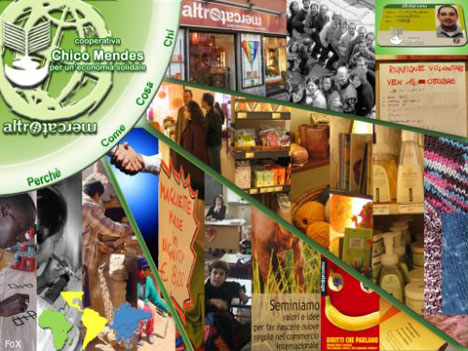
Bottega Altromercato, an example of social innovation from Sustainable Everday
"The main activity of designers will be as social innovators," said Ezio Manzini during an intimate conversation with o2NYC on May 6. Ezio's talk outlined an exit strategy for conscious designers, a shift from making things to designing tools for a better society. For those of us who have signed on to the green revolution, who commit to having the conversation with clients, sourcing better materials, reducing life cycle impacts, doing the hard work of greener design, we need an exit strategy. How do we stop making things less bad and start actually solving for climate change?
Ezio Manzini has been thinking about the sustainable design problem for 20+ years. A professor of Industrial Design at Milan Polytechnic, he is Director of CIRIS (the Interdepartmental Centre for Research on Innovation for Sustainability), and is the author of several books on sustainable design: The Material of Invention, Artifacts: Towards a New Ecology of the Artificial Environment and Sustainable Everyday. Ezio feels he has "been telling the same story for 20 years. Always change it by the end it is the same." What has changed lately, though, is his rhetoric, from the soon to be possible to the here and now. That is the opportunity that crisis brings – a chance to rethink how we've been operating as a society, and offer new visions for how we can live.
Ezio first pointed out the problem with the green design movement, and its focus on "fixing the past," which is "doomed because it requires asking people to 'reduce,' asking them to have 'the same, but less.' Instead we need to offer them 'different, but better.'" So what's better?Ezio points to a movement started in Europe that's recently gained ground here in the US: Slow Food.

Findhorn Ecovillage, an example of social innovation from Sustainable Everyday.
A response to the negative effects of an industrial food system, Slow Food provides access to local, diverse food sources, connects them to actual farmers, and celebrates quality. Slow Food is not a product innovation like organic packaged noodles or natural chocolate cookies, it is a product service system that enables end-user consumer to become co-producers of the food that they eat. The end result creates a better tasting product (the food), a more authentic connection to the food (transparent production chain, relationship with farmer), and enjoyable experience (participation in community supported agriculture, communal meals in natural settings).
So what is social innovation exactly and how can designers help?
A definition from EU President Jose Manuel Borosso: "Social innovation means the design and implementation of creative ways of meeting social needs. It covers a wide field ranging from new models of childcare to web-based social networks, form the delivery of healthcare at home to new ways of encouraging people to use sustainable means of transport." We can begin to see the designer's role then in this process. The skills and practices that are unique to designers can be applied to find the next social and sustainable innovation, and to amplify its adoption:
Designer Vision Much of the work and practice in social innovation to date has been lead by social scientists, economists, and NGO workers – long on policy, short on truly creative problem solving. Designers can fill this role by being realistic optimists, by looking for opportunities that require this kind of innovative design thinking, and stimulating the strategic discussion with visions, proposals, and tools to implement change. As Ezio says, "there is a difference between the transformation that happens normally and a designed system. Designed systems are stronger and more replicable. Designers transform an idea into practice."
Product to Prototype "Prototypes are appearing. they provide the building blocks of a future society." What can a designer bring to the equation? "The challenge is to transform the prototypes into products." To learn from the small and local, and to reinvision how an edge practice can become mainstream. Designers know from experience how to transform prototypes into products, and know the promise and limitations of this work. The very act of creating a prototype has value, as Ezio reminds us. "The purpose of a prototype is to show that something is possible."

Cafezoide, an example of social innovation from Sustainable Everday
Right now, those prototypes are emergent as grassroots one-off examples in neighborhoods all over the world but are the work of local heroes. Community supported agriculture. Timebanks. Neighborhood gardens. Co-housing. How do we create a model where this kind of social practice becomes the norm, and does not require heroics to succeed?
Designers also know, however, that in the work of moving from prototype to product, something is often lost, "this is not without risk as they lose some of their original qualities." The role of designer then shifts from making things into mass produced consumer objects, to shepherding local sustainable practices into wider mainstream society.
Enabling Solutions An evolution of product service systems, enabling solutions go beyond meeting customer needs to allowing individuals or communities to achieve their own results with their own skills and abilities. Slow Food is a solution that works because individual actors participate in a system that creates value for everyone involved. Materials are becoming scarce, but "in a small, densely-populated, highly connected planet, social resources are the most abundant." The work of the designer then is not to solve the problem with a perfect object or service, but to create a platform for co-designing with individuals in context within their local community.
Networks and technology are not the solution, but the enablers to more effective social innovation. "Social innovation in the age of networks is a process of change where new ideas are generated by actors directly involved in the problem to be solved. ...The objective of design is to create more probable conditions to act in a collective and collaborative way. We create the conditions, not the solution." The aim is a society where people use their capabilities and enjoy doing, playing their role in the solution, rather than passively consuming the end product.
From Volunteer Activity to Day Job The biggest leap of faith for everyone in the room during Ezio's talk would be to follow his logic that the designer's "day job" will be the work of social innovation. "In the social economy this should be our primary work. Not something we do on the side as charity." Indicators that this shift may be happening sooner than the distant future:
Government-supported: The Obama administration has announced its intentions to launch a Social Innovation Fund. EU political leaders are similarly talking about the role of creative problem solving as the path to sustainable innovation.
Non profit: Talk of social innovation thinking is on the rise in the non profit sector, as these groups start to see the benefit applying design-led thinking to the way they diagnose, solve, and scale for societal need. Brainstorming, IDEO method cards and sticky notes are of benefit here.
For profit sharing systems: The rise of co-working, product-sharing solutions is on the rise. In a report Ezio published with François Jegou, Collaborative Services: Social Innovation and Design for Sustainability, documents the rising popularity of sharing-based business models, built on networks of information technology to set up personalized hubs. Zipcar, CityCareShare, I-GO and Citywheels are examples where technology made a sharing model more on-demand, and more scalable.
Products for sharing: The future of co-housing, or shared community spaces, will demand a redesign of products like washing machines and daily household objects. How else to keep track of your percentage ownership, use, care and maintenance of a community-owned device.
Small, open, local connected: For those chomping at the bit to start designing for social innovation, now, Ezio reminds us that the best projects start local as experiments, local people solving local problems. To start the work of social innovation, look around the corner, find out what's happening in your city or neighborhood, and join a grassroots effort today. Just remember to spread the best ideas, and send them to Ezio. The need is great. Now is the time. "We need radical change; increasing consciousness is not enough."
(credit to Allan Chochinov and Robert Fabricant for supplying Ezio-isms).
Jennifer van der Meer is a strategist and activist focused on developing sustainable relationships between people, products and brands. By day, Jennifer works on brand collaboration communities with Drillteam and is an Adjunct Professor teaching sustainable design at NYU ITP. By night, she serves on the boards of o2NYC and the Designers Accord and lives in the West Village of New York City.
-
oFavorite This
-
QComment
Share your thoughts
Directory Company Profiles

Core77
Industrial Design
Resources
Industrial Design
Resources
-
Core77 Directory
Find the Best Industrial Design CompaniesGo -
Brainchild Engineering
Brainchild Engineering, based in Northville MI, is a product development and engineering company ded...
-
Springtime design
Springtime is a creative force that develops exciting, sustainable and paradigm-shifting products, b...
-
DesignThink, Inc.
DesignThink is a full service product development group focused on defining, developing and deliveri...
-
Acorn Product Development
Acorn Product Development is based in Silicon Valley with design centers in Boston, Denver, Los Ange...
-
studioFAR
Established in 2009, studioFAR is a softgoods design firm based in the Mission district of San Franc...
-
Hatch Duo, LLC
Founded by an award-winning team with over 20 years of combined product design experience, Hatch Duo...
-
Datum3D Product Development
Datum3D is a one-stop shop product development company located in the Greater Boston Area. Founded i...
K
{Welcome
Create a Core77 Account
Already have an account? Sign In
By creating a Core77 account you confirm that you accept the Terms of Use
K
Reset Password
Please enter your email and we will send an email to reset your password.