
e
Behind the Scenes: frog design on the Nautilus Mobia

Written by Tony Meredith, Remy Lebesque, Cormac Eubanks, Howard Nuk, and Michael DiTullo.
Working out at home may be convenient and cost effective, but why do the machines for home use echo gym units so closely? Can a home machine be appropriate for and respond to the home environment it is meant to live within? Can we make it a source of pride so it does not become layered with laundry or relegated to the garage? The frog design team asked these types of questions when we partnered with Nautilus to take a fresh look at their Treadclimber products. Together, we tore down the existing product and built it back up to become the Mobia, more reflective of its intended environment and users and more efficient in its manufacturing process. We designed it to be visually iconic, with reduced parts and cost, and passed those benefits to a larger audience by producing it at a lower price point than its predecessor.
We spent an initial block of time in a primary and secondary research immersion by diving into competitive products, learning about the retail environment they are sold in and identifying and observing a group of home exercise users in their domestic settings. We found that the majority of existing home workout machines had finishes that tended towards dark paint and metal accents, having more in common with an assault rifle than the living room. While this look and feel might be appropriate to a high tech commercial gym where everything is focused on working out, it feels alien co-existing with a family in their personal space.
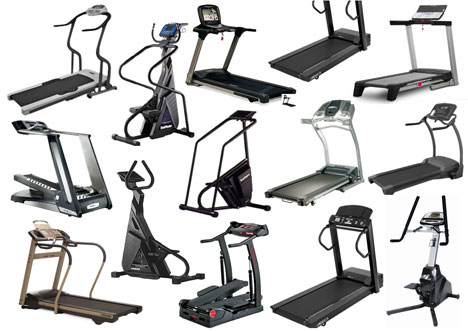


The visually aggressive machines above lurk in the most mundane of home environments. If you put pillows on the deck of the treadmill below, it would make a very nice bed for a small guest.

Or what about this treadmill just stuck in the corner with the television pointed at it? Not exactly the luxurious bedroom look you might be going for.

Even in rooms where a professional interior designer was obviously involved, exercise machines stick out like a sore powder-coated thumb.

Multi-purpose office-and-workout rooms are the saddest of them all. This room is begging you not to enter it; it feels like a torture chamber.

Getting back into the studio for an initial whiteboard session, we listed out existing characteristics we wanted to avoid, while compiling a list of opportunities to build something different than the competition, something that actually belongs in the home. We knew we wanted to stay away from dark and harsh materials. We wanted to create a more holistic design that bridged the complex mechanisms. We wanted the device to look like it belonged in the home without specifically picking up superfluous accents of a particular style of home décor. We wanted it to be inviting by being understandable. In our project room, we posted up images of the people and homes we investigated to continually remind us who we were building this for. Armed with a sense of where things were and where we wanted to take them, we busted out the bic pens to develop a language that felt like it belonged.

Three directions rose to the top and warranted further development. First, the direction seen rightmost in the image below mixes architectural elements with those of contemporary consumer electronics the user might also own to create a hybrid language that feels like it belongs in the home, while retaining a technical and confident feel. The second concept takes the more traditional construction of existing machines and overlays a logical framework, making a stronger overall silhouette. Finally, the third direction feels more angular, picking up on cues found in contemporary furniture, but skewing them slightly to lend a sense of motion and hint at the device's function.


At frog we believe in a convergent process in which industrial, interaction, and graphical user interface design are done in parallel—if not in the same room—whenever possible. True to form, as we defined the architecture of the form language, we were also building GUI concepts that reflected the overall themes. We wanted to break away from the tradition of using raw LEDs and develop something that felt more refined, revealing itself when needed but remaining hidden when not in use. Our solution: a construction that transmits workout information through a seamless plastic sheet to reduce the number of parts in manufacturing—usually a good way to lessen costs—keep the instrument panel impervious to liquids like sports drinks or perspiration, and achieve that hidden aesthetic. With only four buttons, using the Mobia is simple and intuitive. When not in use, the LED readouts disappear for a clean look.
frog and Nautilus then regrouped to review which direction we felt matched the initial goals most closely. As often happens, we discovered that each direction had strong elements that needed to be in the final product. Specifically, these were the home-meets-consumer-electronics language from the first concept, the stronger silhouette of the second, and, finally, the horizontal read of the GUI from the third. We set about the task of remixing and editing those elements into a cohesive holistic vision. When done right, the result of a refinement session is a stronger design.


As we honed the details of the final design with our internal engineers we began the task of preparing production documentation for the Nautilus team. Ed Flick and his design and engineering team started the long process of finalizing the design, simultaneously costing out and sourcing components, selecting materials, conducting LED studies, making electronic and assembly technique prototypes, matching color with flame retardant plastics, gathering powder coating samples, studying motor cooling ventilation, investigating graphics, refining ergonomics and interface design, and reducing cost—all while maintaining the design vision. The last 10% is always the most arduous—so much can go wrong or simply be costed out. The Nautilus team did an amazing job developing every detail, and with design languages that are this simple, every detail must be executed superbly.


Above is a small-scale FDM grown model and a full-scale foamcore model of the Nautilus Mobia. Mock-ups like these help us to iterate through details and find solutions that are impossible to refine otherwise. Economically designed for fast assembly, the Mobia is shipped to customers in three easily handled boxes, saving money and resources. Nautilus is a customer-driven company, so white glove delivery and assembly is available to most all purchasers.

In just one year, Nautilus brought an entirely new product to the market. As designers, we rarely get to see a mass-produced project that challenges the status quo to this level and is fully commercialized in such a rapid time period. This speaks volumes to Nautilus's commitment to great product, the work they did to generate a brief they truly believed in, and their dedication to our joint vision, working closely with vendors to implement a product so true to our final design. Ultimately, the Mobia enabled Nautilus to bring the cost of the unit down 20%, opened up an entirely new market for them, and, best of all, makes home fitness more appealing and affordable to end users.


-
oFavorite This
-
Q29Comment
Directory Company Profiles

Core77
Industrial Design
Resources
Industrial Design
Resources
-
Core77 Directory
Find the Best Industrial Design CompaniesGo -
 Whipsaw
Whipsaw, under the leadership of design visionary Dan Harden, is a highly acclaimed strategy, indust...
-
Sundberg-Ferar | Product Innovation Studio
Sundberg-Ferar, a product design firm, helps the world's leading durable product companies to turn c...
-
Bluemap Design
BlueMap design is a multi-disciplinary product development firm. Founded by Simon Yan in 2001, the f...
-
Tactile
Tactile is a product and UX design firm founded in 2004. Blending physical and digital design, we cr...
-
Open Design
We partner with teams to deliver fresh thinking and award winning products for passionate audiences....
-
Tandem Product Design
With a stellar record of design and engineering successful products with World Class brands since 20...
-
James Owen Design
We've been focused on robust and thorough design and product development consulting with a healthy d...
K
{Welcome
Create a Core77 Account
Already have an account? Sign In
By creating a Core77 account you confirm that you accept the Terms of Use
K
Reset Password
Please enter your email and we will send an email to reset your password.
Comments
No matter how beautiful it's made, it's still an eyesore even in the most modern of bedrooms or living rooms. Unless you are able to put a nice cover over it and turn it into a mini-bar or table. ;) But no matter how you slice it or design it, exercise machines will never be furniture. They belong in the basement or exercise room.
That was my favorite line in the article! Thoroughly enjoyed this article. I can't help with agree with some of those on here who think that now instead of it being black and being obtrusive, it is now equally as obtrusive but in white. It's gorgeous, no doubt and I am sure Frog had great intentions. On the other hand, maybe this piece of equipment was meant for a modern household, city dweller with modern taste in furniture/home decor? But that is not reflected in the demographic and in the observational and ethnographic research photos displayed above, which shows a more traditional environment in which yes... this machine would surely stand out and not blend in with its environment.
I'd love to see a response from Frog to these comments as many people seem to feel the same.
Shame there's no scenario pictures in real homes to back up the gas.
I think it looks too thick and heavy, but otherwise I like the direction. By the way, my house does kind of look like that. (Don't you guys have IKEA?)
While designing fitness products for the home is good in theory, I don't know if it's the best strategy. First, customers who buy fitness equipment are familiar with club equipment and when they see a product that looks similar, they automatically assume it is of higher quality. Second, the stores who sell this equipment are set up like a gym and the machines do look perfectly at home in that environment.
Good concepts for the interface and display but the final version looks cheap. The concepts filled up the space better.
It'd be great to see a follow-up in 2-4 months showing the outcome and based on reliable information.
You may want to check the Consumer Product Safety Commission website to verify: http://www.cpsc.gov/
Dubious: consumer electronics approach to fitness equipment; lack of supplementary rack/storage areas; angled side arms means your towel slides off...?
Meh: Appropriateness of final solution to the original design problem of fitting into the home; final design is about as appropriate as placing a washing machine in your living room.
The Treadclimber was kind of a big deal when it launched, until mechanical failures caused the company to recall every single one of them.
I would love more of these articles that reveal the background story. I agree with Mark, also having worked in this industry for years, there is an industry wide mentality that this minimal styling will not impress or hold up against the agressive styling of the competitors.
Although I enjoyed your holistic approach to all of the issues this product presented. It seemed a bit more work could have been applied to the Assembly process. It looks like you have about 14 steps, with some moderate to complex assembling. Might be interesting, after the fact, to follow up with Nautilus' customer service to see if you could have improved this process. Seems like a potential interface project that maybe got lost amongst all the other details.
All in all, Awesome Job!
Also, Core, kudos on this post. We need more posts that honestly address the process of design and especially that "the last 10% is always the most arduous".
I will definitely use this as an example on my classes. People are always too afraid to innovate. Most people say "let's see what the others are doing and make it similar. If it works for them, it will work for us." That's not always the best way to follow.