Well folks, every time you bite into a Gummy Bear, that there is what you're crushing and grinding up with your teeth. I hope you're happy.
And maybe you'll think twice about letting your child toss their toys about the room so casually, once you consider the fragility of those toys' innards.
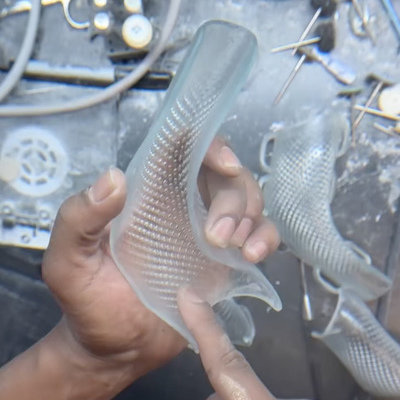
These hand-sculpted objects are the work of artist Jason Freeny, who graduated from Pratt in Industrial Design. On his Facebook page he's even got some process shots:
"Believe it or not, a synthetic paintbrush proves to be one of the best sculpting tools."
Okay, does anyone want to guess how artist Bradley Hart made these portraits? Any clue what those pixels are, arranged in that neat hexagonal pattern you've clearly seen before?
Even if you puzzle out that Hart can buy some of the raw materials for his work at the UPS store, you'll probably not guess how he added the color. Hit the jump to see.
For many of you, landing an auto design gig would be the end-all be-all. But imagine having that job, with all of its demands, and still having enough creativity left over to do your own art on the side.
Craig Metros is a Ford designer from Detroit, now transferred to Australia. In his new home base of Melbourne, Metros has rented a garage-studio with five other guys, and in his off hours, creates art (primarly car-based, you can check his pieces out here) and works on machines. Watch the video below and decide which of his lives you envy more.
Cliché though it may be, it's hard not to describe it as anything less than a gift that keeps on giving: still from the devastation of Superstorm Sandy, a Long Island waterfront community has united to upcycle some 3,000 Christmas trees as an ad hoc solution in the interest of rebuilding protective sand dunes. Several Long Beach residents proposed the solution, which was approved by city officials and implemented by volunteers last weekend. Per the New York Times:
Healthy sand dunes are the first line of defense for coastal towns during storms because they keep the ocean from invading backyards and basements. But sand alone is not enough. An anchor, often naturally growing grasses, is needed to prevent the sand from blowing or washing away.
But the grasses cannot grow without a significant accumulation of sand, and in Long Beach these days there simply is not enough. That is where the Christmas trees come in.
"The trees act in place of natural plant growth," said Charlie Peek, a spokesman for the parks service in North Carolina, which has been using Christmas trees to spur dune revival for years. "It gives it a little head start, a little bit of a helping hand. In an ideal situation, the plant growth comes in after it and starts building a natural dune."
The method is not uncommon, particularly in areas like the Carolinas and Florida that are prone to hurricanes. It can take two to three years for dunes to become fully re-established after a major storm.
The commendable community effort is an uncanny echo of an art installation from almost exactly a year ago to date, Klara Lidén's widely acclaimed Pretty Vacant at Reena Spaulings, a second-floor gallery space that happens to be above one of my regular dim sum spots. The main attraction of the solo exhibition, "S.A.D." (after the mood disorder), consisted of a medium-sized room filled with a faux forest of some 80 discarded but otherwise intact Christmas trees. New York Magazine's Jerry Saltz nicely captured the redolent sentiment of the installation.
Immediately inside, you're confronted with the startling sight of a space filled with discarded Christmas trees, all scooped up from the sidewalks of New York by Liden and her cohorts. A disruption of the senses comes, thoughts of the Brothers Grimm, the foreboding of forests, inchoate uneasiness. You see only a few feet in front of you. Still, there's space enough between the trees to proceed. Make your own way in, push trees aside, slide through...
Unlike almost all artists who fill a gallery with one thing, be it glass jars, wooden beams, or cotton bales—a trope so worn-out it should be banned—Liden places a leather couch in the center of the room. It churns up everything, getting you to stop, look, listen, smell, and maybe shudder.
We've seen the insanely complicated things people can do with paper by painstakingly folding it (Matthew Shlian) or cutting it by hand (Bianca Chang). It was just a matter of time before another OCD paper artist/engineer got his hands on a laser cutter and made things really complicated.
Artist Eric Standley, a SCAD grad and now associate professor at SVA's Virginia Tech branch, painstakingly assembles hundreds of sheets of differently-colored laser-cut paper. The intricate shapes evoke stained glass windows or something you would carve if you were imprisoned for 30 years. This man has the focus and patience of a sniper on Adderall.
Frumpy Chairs, "Poly" and "Mary-Kate" (left to right)
Toronto born and raised, Jamie Wolfond is currently a senior at the Rhode Island School of Design in Providence, Rhode Island. We first profiled his Extraterrestrial Seating earlier this November and are excited to share his newest endeavor in seating design. A proponent of big messes, loud noises, and hard work, Wolfond epitomizes that in his latest project, which is no exception.
Frumpy Chairs are one-of-a-kind plastic seating, where the experimental process behind each piece results in a series of totally individual chairs, none alike. With Frumpy Chairs, Wolfond brings together the seemingly disparate worlds of 'hand-crafted' and 'plastic-molded' to create completely unique plastic chairs.
The entire Frumpy Chair Series
The chairs are made from plastic regrind, which are chunks of failed injection-molded parts that would otherwise go to waste. Sourcing the material from factories throughout the country, Wolfond was able to get over 350 pounds of regrind donated for the project.
Following his "#1 most-funded sculpture project in Kickstarter history," Chicago-based multicreative Joshua Harker's on the crowdfunding site once again. Expressing his signature blend of art and design, Harker's not hawking a functional object per se; his beautiful, 3D-printed sculpture, which combines the skull that was so successful the first time around with a new set of articulating wings, was created "In honor of the developing 3rd Industrial Revolution."
Representing the project is a 3-piece sculpture entitled "Anatomica di Revolutis" (loosely intended to mean "Anatomy of the Revolution"). Each component is designed to assemble together to present a larger narrative about the developing 3rd Industrial Revolution. The fully assembled sculpture... symbolizes liberty & prosperity through an empowered participatory populace. It is designed to hang on a wall or other vertical surface.
...The wings are comprised of 75 separate mechanical moving pieces that are printed in their entirety as a single working assembly. They are symbolic of the mythical Phoenix rebirth & spring from the fire theme interpreted by my "tangle" aesthetic.
Man this is trippy. In the beautiful facility you see pictured above, Seattle-based artist Etsuko Ichikawa draws using molten glass and fire. It's one of those things where words doesn't do her process any justice, but luckily there's video of it:
As "an artist and designer who encourages us to reconsider our ideas of beauty and aesthetic value," Sander Wassink is more concerned with concepts than saleable products. Thus, his statement reads like that of an artist than a designer:
How can we reconsider what is important and what is desirable to include notions of history, memory and the preservation of a past which is slipping away. Amid new construction, new production, and constant proliferation of new forms and facades, Wassink turns his attention to the discarded, the abandoned, the left over and attempts to reimagine what can be done with the already partially formed. What new possibilities exist in the surfaces and materials that are half-built or half-destroyed. Whether his object is the partly demolished façade of an abandoned building, or the everyday detritus from our over productive culture, Wassink asks what new forms and new visions of beauty already exist to be discovered and appreciated.
Yet there is a distinctly designerly quality to "State of Transience," a series of large-scale photographs of hypothetical chairs that the Wassink has created in a semi-arbitrary iterative sequence. The chairs themselves are compellingly vibrant yet somewhat grotesque, mutants whose existence is justified by duly non-teleological process of evolution:
The ongoing project, State of Transience, is a responsive design process, which is continuously shifting over time. Using the relatively simple design archetype of a chair, Wassink repurposes materials, making additions, subtractions and mutations, to suggest the impossibility of a final or fixed form. Each new version of this chair, documented in incremental stages, shows evidence of it's past constructions and glimpses into it's future potential. Every new state is a testament to ingenuity of human production and the fragility of supposedly rigid constructions. In this way the project maintains a lineage of its arrangements, preserving both it's past iterations and suggesting future possible developments simultaneously. The goal is not a finished product, but instead a material history of combinations and constructions.
Over the next few weeks we will be highlighting award-winning projects and ideas from this year's Core77 Design Awards 2012! For full details on the project, jury commenting and more information about the awards program, go to Core77DesignAwards.com
The Chromatic Typewriter is a conceptual art piece consisting of a modified late-1930′s Underwood typewriter that types a spectrum of colors, rather than the letters of an alphabet.
How did you learn that you had been recognized by the jury?
I saw the results on the C7712DA website on my lunch break from work. It was a very happy lunch break.
What's the latest news or development with your project?
The Chromatic Typewriter is heading to Grand Rapids, MI for ArtPrize September 19 to October 7, 2012! It will be on exhibition at the Federal Square Building—the SPOT. I'd welcome some votes!
What is one quick anecdote about your project?
My primary medium is painting, and the exposure generated by the typewriter assured that many people assumed my paintings were typewriter-generated; some bloggers went so far as to juxtapose the image of the typewriter with some of my larger five-foot-by-seven-foot paintings!
What was an "a-ha" moment from this project?
Definitely when the project was first conceptualized: I rolled a watercolor into a typewriter carriage to type a poem on it and the idea hit me. The first mock-up of color on the keys was a very exciting 'a-ha!' moment.
No, it's not an unseen CG image from Inception, though it's certainly cool enough to be. These are pictures of BoomBox, an installation made entirely out of cardboard boxes by French architect, Stephane Malka. Created for the 2011 EME3 International Architecture Festival in Barcelona, Boombox somehow escaped everyone's notice, including ours, until now. We think that's a real shame because it's rare to see such an immersive, experiential installation made from such simple materials. By simply projecting various lighting configurations onto a wall of cardboard boxes, Malka completely transforms an everyday object into a powerful environment.
The concept for BoomBox stems from Malka's belief in democratizing architecture. He calls it his "eulogy to cardboard, a cheap material symbolizing nomadism [in] contrast to stone, a noble material representing longevity in all its static weight. Although separate entities, there is nevertheless an exchange between two bodies, a cultural and social fusion between the academic and contemporary, at the crossroads between a work of art and a work of architecture."
I have the utmost respect for anyone who still hand-draws illustrations with a pencil and Rapidograph. French illustrator Ugo Gattoni, inspired by the 2012 London Olympics, spent freaking 723 hours putting together an intricate 16-foot-wide drawing of a bicycle race through a surreal London (see the video after the jump):
Let the graffiti games begin. With the Olympics just mere days away, street artists have been making their presence known around England. Even Banksy couldn't resist an opportunity to show his satirical support with these two new pieces. One stencil features a javelin thrower armed with a missile while the second is a portrait of an Olympic pole vaulter in mid-jump landing in the direction of a filthy mattress below.
Equally impressive is other Olympic-themed work that has cropped up all over. This timely McDonald's jab (in case you aren't aware McDonald's will be the only French fries, or 'chips' sold at London Olympic venues) by an unknown artist was photographed by Pogorita outside the Brighton tube station.
Even this piece of a female diver plunges headfirst into an open toilet captured by Tim Callaghan makes quite the provocative statement. And a multi-colored pigeon by Ronzo depicts city birds getting in on the action.
Seeing beautiful street art in London? Leave a comment on where we can see more work below!
Painter and muralist Josef Kristofoletti is pleased to present his latest project, the "Atlas Detector," commissioned by none other than the ATLAS Experiment at CERN, which is headquartered within the otherwise nondescript building. While we eagerly anticipate confirmation of a certain recent discovery, the Austin TX-based artist has recently completed his eyecatching rendition of the very same.
The three-story tall mural was painted by international artist Josef Kristofoletti on the side of the ATLAS control room directly above the detector, near the Swiss-French border outside of Geneva. This project was inspired by the same questions that the physicists at CERN are trying to answer; where did we come from, what does it mean to be human, and what is our place in the universe. The artist worked closely on location with physicists at CERN over the course of a year to create the mural. It depicts the artist's interpretation of what the Higgs boson might look like.
Sven and Nils Völker—graphic designer and installation artist, respectively, though they both do both—are pleased to present a pair of new installations at Flø in Ulsteinvik, Norway.
For the art festival "Go with the Flø" in Norway we've turned an old school gym into one large installation. It's an interplay of two site specific installations which fill up the whole room.
On the wall is the work "Haven't Seen Myself in Ages" by Sven Völker. A huge wall of 414 posters which are illuminated by color changing lights. Thereby the appearance of the whole wall is constantly changing and different forms appear and disappear again.
The middle of the room is dominated by the installation "Twenty Eight" by Nils Völker. A 15 meter long double row of white plastic bags which are selectively inflated and deflated in controlled rhythms creating wavelike patterns and a sizzling soundscape.
As a column of inflatable plastic bags, "Twenty Eight" is ostensibly a rework of "Thirty-Six," which was suspended ceiling as a sort of respirating chandelier. His brother's work, on the other hand, is easily the cynosure of the space: the kaleidoscopic pop hues belie their simple paper construction.
This is pretty awesome: Battle at the Berrics is an annual skateboarding competition (the Berrics being the name of an L.A.-based skatepark and training facility). After last year's competition, the losers were asked to donate their old and busted-up skate decks. Then, Tokyo-based artist Haroshi was commissioned to turn the broken decks into the trophy for this year's competition.
Watch as Haroshi bangs it all out, from start to finish via scroll saw, Dremel, chisel, orbital sander and more:
Bristol-based "visual label" AntiVJ is pleased to present their latest project, "O (Omicron)," a permanent installation at the Centennial Hall of Wroclaw. (I'm not sure what their self-proclaimed designation means either, but, if their work is any indication, it's a contemporary take on an atelier or studio.) Directed by Romain Tardy and Thomas Vaquié, the large-scale, site-specific light and sound piece was two years in the making... roughly the same amount of time it took to build the dome nearly a century prior.
It is reasonable to think that when Hala Stulecia was built in 1913, Max Berg's ambition for his construction was to pass the test of time. What could have been his vision of the monument in the distant future? How did he imagine the olding of the materials? The evolution of the surrounding urbanism and populations?
The edifice is often cited as a canonical example of reinforced concrete architecture, and, at 65m in diameter (roughly the size of Columbus Circle), the designers note that the Centennial Hall is "the largest dome built since the Pantheon in Rome eighteen centuries earlier." No wonder, then, that the modernist marvel was deemed a UNESCO World Heritage Site in 2006.
A deliberately minimalist visual aesthetic allowed to highlight the very architecture of Hala Stulecia's dome and re-affirm its place at the core of the piece. Minimalism also appeared to be the most appropriate means of conveying this idea of future at different periods of time (from 20's/30's anticipation film to more contemporary productions ). But the use of these references was not simply formal: the vision of futuristic totalitarian societies seemed to echo back real moments in the history of the building, warning us against the dangers of an idealized vision of the future.
Inspiration for the music composed by Thomas for this project was found in both orchestral work, echoing the colossal size of the architecture, and electronic textures, evoking the action of time. The score also tried and recreate a sense of evolution of the materials used for the dome structure, and their sonic aging.
By using references such as Fritz Lang's Metropolis or the utopian projects of Archigram to confront the different visions of the future at different times, we were interested in trying to create a vision of a future with no precise time reference. A timeless future.
Omicron? More like Omi-Tron!
I'm not sure if readers are better served by watching the 'Making of' clip before the actual piece, but both (after the jump) are well worth watching; where the video of the installation suggests the sublime (full screen highly recommended) in the straightforward edit, it's impossible to grasp a sense of scale. The process piece provides a reference point, showing persons in the massive atrium, but it's ultimately the sort of thing that must be experienced in person (not least because the audio, like the visuals, takes across all 360° of the space).
Douglas Young, co-founder of Hong Kong lifestyle brand Goods of Desire, recently exhibited a large-scale installation at the Hong Kong Art Fair last weekend. The architect-turned-entrepreneur's "Quantity Has a Quality in Itself" is intended as a comment on the city's history.
There was a time when Hong Kong was the center of the plastic toy industry. The colorful water pistol was one of its icons. Its lurid colors and poor quality construction s a far cry from the world of Art. But nothing succeeds like excess. By putting them in a new context, they are able to develop a different (and hopefully more positive) appeal. Just like Hong Kong itself, the attraction is the result of its inherent contradictions.
Sociopolitical implications of firearms aside, the use of a summertime plaything also suggests an element of timeliness—or, more specifically, novelty. The day-glo colors and cheap plastic construction serve as shorthand for Pop Art, but the sheer abundance transcends the scope of kitsch. Meanwhile, a few of the water guns have been adapted into lamps, but the components are largely left intact, such that the installation comes across as unambiguously decorative: visually striking for sure, but rather less substantive than, say, Ai Weiwei's "Sunflower Seeds."
Brooklyn-based designer Sebastián Errázuriz is prolific if nothing else, as evidenced by his strong showing during New York Design Week. Of course, seeing as we saw fit to include his "Chicken Chair
in the First Annual Core77 OPEN he's clearly something else: a hybrid artist/designer who is as comfortable producing commercial work as he is with realizing conceptual projects, transcending both the line between art and design, as well as the dichotomy between novelty and philosophy... often within a single work.
His latest urban intervention, "Wall Street Nation," might be considered a follow-up to his "Occupy Chairs"... or a riff on the notion of 'painting the town red':
Following his signature style of minimal yet uniquely creative designs and public interventions; Sebastian Errazuriz unveils his latest project titled "Wall Street Nation". The artist has started to transform street lines into "Dollar Signs" by simply painting a white letter "S" across each line. The project wishes to express the fear and impotence that people are currently experiencing while seeing the growing greed that is transforming the way we live.
"I'm afraid greed is rapidly changing life as we know it; it's become normal that while home owners are being evicted, banks considered "too big to fail" are shamelessly gambling to with citizens money. The 99% are intimidated by their own police force while judges rule that companies have the same rights as people. Now corporations are pouring unregulated amounts of money into Super PACs to influence the elections and secure politicians that will continue to de-regulate the market and make them more money. It's all spiraling out of control; greed is taking over and people are loosing all sense of proportion and justice."
The artist hopes his painted Dollar signs on street lines are taken up by others who also believe that greed has been taking over their cities and displacing their way of life. "If people feel impotent and cornered by how greed is transforming everything; I invite them to get a brush, a can of paint and go out and change their street lines into Dollar signs. People need to find new ways to remind others of the general discontent. I need to go and mark some Dollar signs on Wall Street..."
For its New York debut, the Frieze Art Fair was held on Randall's Island Park, in an expansive 225,000 sf. tented structure custom-designed by Brooklyn architecture firm Solid Objectives — Idenburg Liu (SO — IL). Many Manhattanites were skeptical at first of the location choice, but access to the fair was made easy by regular ferry trips, shuttles from the subway, or quick cab rides from Manhattan. Attendees seemed to enjoy the adventure associated with going to a dedicated self-sufficient location, where they were greeted with outdoor sculptures and installations upon arriving on the island.
The fair hosted 180 international contemporary galleries, representing over 1,000 of today's most important artists. Critics argued that the fair did not bring enough newness and lacked risk-taking on the part of the galleries, but that did not seem to hinder the business of art, with many galleries reporting significant sales on the first day. Overall, the event was well produced, and the high quality of the galleries represented were positive factors that would most likely encourage the fair's subsequent return to New York. In addition, the tasty food vendors nourishing Frieze visitors certainly trumped most trade fair food options.
Repeating themes throughout the fair involved conveying and challenging notions of time and space, as with Darren Almond's piece Perfect Time. The use of color provided splashes of energy, such as Paul McCarthy's blue silicone sculpture portraying the dwarf Sleepy from the classic, Snow White. Many artists created works from found objects, like used clothing tacked compositionally to wood in Tom Burr's These Patterns of Public Display. Other mediums ranged from traditional to unconventional, such as acrylic paint, paper, canvas, wood, textiles, plastic, mirrors, glass, metal, resin, and not to be neglected, Damien Hirst's formaldehyde-preserved dead animals. Physical floor or wall installations and sculptures seemed to dominate the show over paintings, drawings, and video. Design and art overlapped on occasion, with some works serving to both aesthetic and function, such as Andrea Zittel's Aggregated Stacks and Richard Artschwager's impressive red oak and cowhide chairs.
Sculptor Tom Sachs happens to have his studio just up the block from me, but the goings-on inside are well-shielded from the street. I'll occasionally pass by just as the doors quickly open and close to admit or discharge one of his employees, and I always catch that distinctive shop whiff that screams they're making stuff in there.
Sachs (whose "Space Program: Mars" exhibition opens today at the Park Avenue Armory) has a quirky sense of humor fully on display in this "Love Letter to Plywood" video:
The video was directed by Sachs collaborator Van Neistat—remember his brother, Casey?--and is part of a trilogy called "Energies and Skills." Check out the other two, "How to Sweep" and "Space Camp" for more Neistat & Sachs goodness.
"Hypervan (rear down view)" (2008); all images courtesy of BravinLee programs
Film lovers—sci-fi fans in particular—are surely familiar with the work of "Futurist Designer" Syd Mead (we're not sure if he's got issues with the term 'concept designer,' but we'll grant him the exception), and even the masses ought to recognize his groundbreaking work for the likes of Blade Runner, Aliens and TRON, among other canonical examples of the genre. If Mead's reputation as a visionary visual artist is all but surpassed by those blockbusters, the current exhibition of gouaches—spanning the four decades of his career and counting—at BravinLee gallery in Chelsea offers a fascinating look at his work in a fine art context.
Mead's vision of the future is sleek, erotic, and glamorous. It is populated by impeccably dressed, trim and tanned 1%ers and smartly uniformed worker bees. Mead is fond of portraying the arrival of guests or travelers in the act of greeting their hosts, which allows him to focus on the vehicle in the context of a short narrative sequence. The fantastic conjectural machines seem more plausible when placed in a richly detailed context and in a familiar situation. With few exceptions, Mead's future is utopian, free from famine, litter, security lines, corpulent tourists in cargo shorts, white socks and traffic snarls. Almost invariably the result of a client's commission, Mead once described his work as the lubricant for capitalism...
As a vehicle to celebrate emerging artists in one space, The Pulse Art Fair opens today at the Metropolitan Pavilion with an array of artists and disciplines including video art, dance, and architectural installation. Last night, I had a walk-thru with Cornell Dewitt, the fair's director, to go over the spatial and architectural-bent arts present in the show. He says that Pulse makes it a point to be "accessible, literally and metaphorically." In a city that hosts dozens of art fairs like the monolith Armory show to the edgy Independent, Pulse tends to run in a glowing medium. It's central location and eclectic mix of galleries makes for great inspiration grounds. The art here can be as opaque as in contemporary art gallery but Pulse strives for diversity. From a young Estonian artist to Fred Wilson, and a Fred Torres collaboration, Pulse's manageable-sized gallery allows for intimate moments with the art and gallerists.
Upon entry, the Lead Pencil Studio installation in the Pavilion's lobby brings the city into an art world space. The plywood set is an architectural take on a Chinatown street, with life-size re-creations of chain-lock doors, post box, fire escape, and storefront. The installation is meant to emphasize all of the formidable pieces attached to a building and it's street life that an architect did not put on that building. We are left with the stark imaginary formations of order and security from urban planning, emergency exits, and an attempt at street art. The plywood objects represent the hustle of city-life, but in their plywood manifestations we are hyper aware of their artful re-imaginings. We remember that we are in an art fair. Dewitt says of the space, "the world is falling away and you transfer yourself, bizarrely into this clarified art world."
"I wish to communicate with you" by Pablo Guardiola, 2011, 28 x 42 inches
“I remember talking to college classmates of mine, there was this general feeling of like anxiety and panic about what our lives were going to be like and the choices we were going to have to make once college ended... I just want to give you the message that it's all going to be cool in the end. It doesn't really matter that much the choices you make as long as you keep alert enough and nimble enough to keep changing course along the way.”
Jonathan Harris spoke to a full auditorium at the Rhode Island School of Design last Thursday, telling stories from his life and some turning points that happened along the way. An artist, programmer, and world explorer, Harris's work focuses on humanizing the Internet in a rapidly expanding digital age.
Harris framed the lecture in four parts chronologically, around turning points in his own life: Internet, Real Life, My Life, Our Lives. Starting with his early twenties, Harris spoke about his focus on the Internet and on looking for stories hiding in data. An interest in collecting found objects led him to the concept of "partial obstruction, partial revelation"—the idea that in leaving space, it allows people to come closer and fill that space with their own experiences. He applied this technique to a lot of his early web work.
“I actually saw the web as a very human place. I saw all of this data, this messy data, that was there had been put there by people and so it was very human. I was very interested in demonstrating this principle when I was a kid, that the web was actually a very human place.”
An attempt to "tease out some of the poetry" from the mess of the Internet led to several projects, including We Feel Fine. Essentially a search engine for feeling, We Feel Fine scans the latest blog posts every two or three minutes looking for phrases following 'I feel...' or 'I am feeling...' Those phrases are collected in a database including the gender, age, and location of the author, as well as the weather conditions when they wrote the sentence. Since its genesis seven years ago, We Feel Fine has amassed about 20 million feelings.
Changing courses dramatically, Harris concluded his first quadrant with a few thoughts on data. "I think data is a very good approach for certain types of insights that you're after, but it's an incredibly limited approach for other insights and it can actually lead to quite superficial insights a lot of the time." Harris no longer believed, as he did in his twenties, that life's problems could be solved through data. Starting to feel like there was a level of depth his data-based projects weren't reaching, Harris began to do projects that involved intense real-world experiences documented himself.
The gods of panel discussions must be working overtime for me this month. I've been to an inordinate number of them, some good, some not so good and none as great as Phaidon's "Viewing Art in the 21st Century: Experience, Screen and Page." It was meant to take up the case for Phaidon's The Art Museum, a "monumental," "colossal tome" that gives door-stopper a new meaning. I have some personal gripes with the book's claim to be "an imaginary museum created and curated...[with] the finest art collection ever assembled." I don't take issue with the art that was chosen—you can't go wrong with a sweeping view of everything from "Byzantine mosaics through Benin bronzes to the abstractions of Brice Marden." The "Mona Lisa" is in there too, of course, prompting one panelist to wonder if anyone still gets inspired by it anymore. Rather, I question the premise of the book itself. Isn't any art book a curated experience, one that can be said to act like an art museum without walls? I suppose, then, that the main difference here is that this book is massive, making it more museum-like than Phaidon's other art offerings? I'm not sure, but woe be the UPS delivery man who had to unload these at the store.
This wasn't addressed by the panel members—Cecilia Dean of Visionaire, Alexander GIlkes of Paddle8, Anne Pasternak of Creative Time and writer Glenn O'Brien, moderated by art critic and curator Carlo McCormick (who let us in on his secret to never feeling overwhelmed or stressed out by museums: smoke pot beforehand). What did follow was a lively hour-long discussion about whether print, as a medium, can stand in for the experience of viewing art in person. Dean made the case for the computer screen as a kind of light box, providing a better viewing experience in some instances, but for certain forms, like video or installation art, there simply is no substitute for an immersive physical space. Imagine racing down Carsten Holler's slide at The New Museum—in a book. That's not to say that if you can't see a work in person you might as well not see it at all. People who don't live near the works they want to see should still be able to access them in some form, and that's where books and the Internet—especially sites like Art.sy—play such a huge role.
The conversation got a bit heated when the topic of curation came up. O'Brien quipped that nowadays everyone thinks they're a curator simply because they can choose things, like collecting their favorite images on Pinterest or Tumblr. While I agree that the term 'curator' is tossed around ad nauseam right now (ushering in a fresh crop of self-promoting model/dj/curators), I highly doubt my fellow Pinteresters would call their boards of cupcakes and shoe obsessions an attempt at curation. Dean pointed out that, at least as far as the Internet goes, there's just too much stuff and we need people to filter that experience for us. Pasternak agreed, adding that anyone can try to play curator online, but there's always room for an informed voice. For more discussion on what curation means today, see m ss ng p eces' new video for Percolate, featuring today's up-and-coming Internet curators.
One of the topics that was brought up at a panel discussion I attended earlier this week was about the problems of publishing catalogue raisonnes. If the catalogue is a of living artist, it becomes outdated the moment that artist creates new work. And even for artists like Picasso, every time one of his works changes hands the catalogue has to be updated. It's a publishing nightmare. Now Art.sy, a new online platform, could make those heavy and constantly out of date printed catalogue raisonnes a thing of the past. Art.sy is still in its beta phase, but I recently got the chance to explore its massive resources. It's powered by the Arts Genome Project, an open source platform that tracks and catalogues every artist, arts organization and every performance, exhibition and event in real time (i.e. no more trips to the printer).
Art.sy expands on the concept by making all that information searchable across more than 800 "genes—such as art-historical movements, subject matter and formal qualities." Feel like looking at blue, medium-sized installations? How about James Turrell's Untitled (19NSB)? Or maybe you want something big and pink? You've now got ten pieces to browse through. You can also choose to only look at works that are for sale or, sift through them by subject matter like "Fantastic Environments," "Text" or "Culture Critique."
But how are these searchable "genes" created in the first place?