You couldn't make it up: a Portland, Oregon-based design duo just launched a crowdfunding campaign to launch a mason jar-based product, designed expressly to brew one of the two beverages that the City of Roses is famous for.
Besides its rugged good looks, it so happens that the mason jar is more durable than the traditional carafe; bedecked in a wool sleeve for insulation and topped off with a maple lid (with a press), the Portland Press is a crafty take on the iconic coffee brewing apparatus (footnote: the origin of the French press is unclear, but the modern version was patented in Italy in 1929; today, it's typically associated with Bodum of Denmark).
Designers always seem to be on a constant quest for the next big material innovation. From the the first application of steam bending in the Thonet chair to things like Glass Snowboards, material exploration is forever married to object design. One of the materials making a minor resurgence in design projects is Tyvek—you know, the stuff you wrap around houses.
Made from polyethylene fibers, the synthetic sheet material is surprisingly strong and waterproof with a paper-like appearance. It would seem there are endless possibilities for what essentially acts like waterproof paper (such as Jiwon Choi's Vases), but among an incredible number of wallets and envelopes there are few other notable products on the market that incorporate Tyvek. At risk of inciting a Tyvek revolution, one might question where are all of the great design projects that make use of Tyvek? One of the cooler applications in the last few years is from New Jersey-based Civic Duty Shoes in the form of Tyvek sneakers.
Civic Duty has been around since 2009, headed by Steven Weinreb. The Tyvek uppers are dyed a variety of colors, allowing a bit of visual distance from their close relatives, the FedEx envelope and disposable work suit. While durability of the Tyvek isn't quite on par with traditional canvas or leather, they do offer extreme lightness and recyclability. While perhaps the perfect application would be a Tyvek portyanki—hard to deny that this is bold sneaker-vation.
The design of the shoes include a nod to classic high top, low top and slip-ons sneaker designs, but the material appeal of Tyvek might not extend too far beyond the design geek demographic. Either way, when you decide to invest in a new pair of kicks, remember that Converse high-tops don't employ the same technology as the construction site down the road.
Sneaker innovation (or the Footwear Novelty Gimmick Contest, depending on your point of view) continues. Hot on the heels of Reebok's crazy ATV-style shoe and Adidas' Boost foam comes Puma's Mobium Runner, a sneaker that "expands and contracts with your foot." Two tendon-like attachments running underneath the shoe, and inspired by the plantar fascia connective tissue on the sole of your foot, reportedly allow the shoe to do this.
Whether or not you believe they work, Puma Innovation Team designer Raymond Horacek looks like he has an awesome gig: Based out of their Japan studio, Horacek sketches, wades through Tokyo, quotes Gaudí and studies cats:
There's no consensus on whether it's better to have more, or less, cushioning in a running shoe; this article crystallizes some of the larger theories being debated, enlisting the opinions of an evolutionary biologist who's conducted biomechanical analyses of how the human foot operates during running. But while consensus will have to wait, Adidas isn't. Yesterday they announced their new Boost foam material, "a revolutionary cushioning technology which provides the highest energy return in the running industry."
The foundation of the BOOST innovation is centred on its cushioning material. Based on a groundbreaking development process created by adidas partner BASF, the world's leading chemical company, solid granular material (TPU) is literally blown up and turned into thousands of small energy capsules which make up the footwear's distinctive midsole. With their unique cell structure, these capsules store and unleash energy more efficiently in every stride. Tests conducted by the adidas Innovation Team show that the highly durable material found only in Energy Boost products provides the highest energy return in the running industry.
Here's a quick vid demonstrating the base difference between Boost foam, the industry-standard EVA (ethylene-vinyl acetate) stuff, and concrete:
Tristan Stoch of Portland, Oregon-based video production company Cineastas recently sent us his latest work, a profile of shoe design veteran Mike Friton. A former track and field athlete with over 30 years of work at Nike to his name, Friton established himself with some of the earliest performance footwear to come from the Beaverton brand, and he continues to innovate as a freelance designer, renowned for his ultraminimal running shoe designs. (His design philosophy is echoed in his web presence: he has no portfolio to speak of, though a quick search turned up a 2011 review of a shoe Friton designed for Soft Star, noting that he was also the brains behind the original Nike Free.)
Besides designing and crafting shoes—Friton is "responsible for many elements of athletic footwear that people wear today"—he's also picked up weaving and paper sculpting in his effort to "explore the fringes of his field." Check it out:
Experimentation in footwear design: Reebok's forthcoming ATV 19+ kicks are meant to be an off-road vehicle compared to the highway-driving passenger vehicle of a regular pair of sneakers. An array of 19 knobby protrusions takes the place of a singular surface, theoretically allowing the wearer to tread on tricky surfaces.
Here's a vid of the design thinking that went into these:
Last chance to enter your portfolio and win a scholarship to the iPensole Footwear Academy! Coroflot is teaming up with Pensole Footwear Design Academy to offer five students a unique opportunity to be part of a footwear design masterclass. Learn about color theory, construction, materials, storytelling and biomechanics in a "learn by doing" environment. REGISTER BEFORE DECEMBER 15th!!
This year, PENSOLE has partnered with the Two Ten Footwear Foundation and FN Platform tradeshow at MAGIC to award scholarships to their footwear design class to 210 lucky students. The programs will begin in January 2013 for a 3-week online class and a 4-week masterclass at PENSOLE HQ in Portland, Oregon. Students and schools are encouraged to apply for either program. But most exciting, work from the program will be showcased at the FN Platform footwear tradeshow in Las Vegas, February 19-22, 2013.
At just under halfway through his Kickstarter campaign for his eponymous "freshoe," French designer Olivier Iguaneye is only a quarter of the way to his £20,000 goal. He might be cutting it close, but we hope he reaches his funding goal for the Amazon-inspired second-skin footwear:
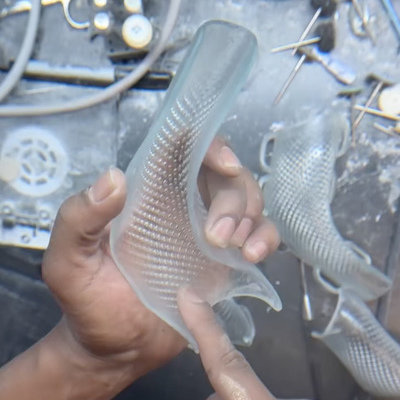
Ok, so that was just the preliminary research for the seamless slip-on shoe, based on the story that "Amazon Indians dipped their feet in the latex from hevea tree and smoked them in a fire to coagulate the first rubber shoes." The final product is far more refined, featuring slits for ventilation an anatomic form developed by footwear specialists Dulster Design.
This year, PENSOLE has partnered with the Two Ten Footwear Foundation and FN Platform tradeshow at MAGIC to award scholarships to their footwear design class to 210 lucky students. The programs will begin in January 2013 for a 3-week online class and a 4-week masterclass at PENSOLE HQ in Portland, Oregon. Students and schools are encouraged to apply for either program. But most exciting, work from the program will be showcased at the FN Platform footwear tradeshow in Las Vegas, February 19-22, 2013.
PENSOLE was founded by D'Wayne Edwards, former Design Director of Brand Jordan, to give talented young design students an opportunity to learn from the industry's best and to provide a farm system for the next generation of footwear designers. Since the first PENSOLE class in 2010, academy graduates have found opportunities with footwear companies worldwide such as Columbia Sportswear, Bluehaven, AND1, North Face, New Balance, Wolverine, Cole Haan, Under Armour, Stride Rite, adidas, JORDAN and Nike.
So ready your Coroflot portfolios and register today! They're accepting portfolios until DECEMBER 15th. Don't forget to check the "Coroflot Member" box when you submit your work!
In the beginning of Yojimbo, Toshiro Mifune's ronin character stands in the wilderness and throws a stick in the air. After it lands, he carefully aligns his feet alongside the stick for several steps, and then he's off for an adventure in the direction the stick was randomly pointing.
What if you've got someplace less random to go? London-based artist Dominic Wilcox's "No Place Like Home" shoes can provide some direction. We've seen GPS-embedded footwear before, made for the purpose of tracking an athlete's progress, but Wilcox has designed his for wayfinding.
After punching in a map destination on your computer and uploading it to the shoes, you click the heels together (nice touch) to activate the GPS link. Then a series of LEDs atop the shoes indicate distance (by illuminating points along a straight line) and the direction you should be traveling in (by lighting up one dot on the perimeter of a circle).
While the shoes work as advertised, they're not production models; Wilcox designed them as one-offs under commission for the Global Footprint project, a series of events to publicize and celebrate the UK's Northamptonshire-based footwear industry.
The worst part about kung fu fighting someone in the dark while wearing sandals is that you can't see when you've kicked them in the head. Well, problem solved:
Sorry, couldn't resist. Those are the Teva Illum 2 sandals, and admittedly the onboard lights are more than a gimmick:
Illum 2 was born from all of the stubbed toes, rolled ankles and black toenails suffered by the Teva Team over the years. Whether they came during dawn patrol hikes down to the beach or late night groover trips around the riverbanks, they hurt - a lot. But all of that becomes a distant memory with Illum's Glow From Below.
Through some design magic, we made the light on the Illum 2 a fraction of the size of the original. It will still get you down a dark trail safely, but now it's barely noticeable when it's light out.
Reebok has long staked a claim to a slice of the sports market, and though it's appreciably smaller than that of the major players, the Canton, MA-based company has managed to stay in the game even as their competitors duke it out in an arms race to sign superstars and rack up medals, both literally and metaphorically. But what's the next step for a brand best known for now-nostalgic Pumps and the aerobics fad?
All images courtesy of Gensler Architects unless otherwise noted
We found out last week, at the grand opening of their first dedicated retail space in the U.S.: in an effort to make the most of their resurgence within the CrossFit community, the Canton, MA-based company is pleased to present the Reebok Fit Hub, a combination store and gym. (The CrossFit phenomenon is a bit too involved to explain here; the uninitiated can learn more at CrossFit.com.) Where Reebok's products are designed to meet the performance needs of occasional gym-goer and diehard CrossFitter alike, the Fit Hub caters to all variety of customer—the Fifth Avenue storefront has attracted a healthy mix of curious tourists, local passersby and fitness gurus.
The staff, of course, is comprised of the latter type: Reebok has made a concerted effort to hire individuals who are passionate about fitness, including trainers and health experts who can provide offer far more guidance than your average salesperson. Moreover, the Fit Hub is the only place to find much of the product, which was previously only available online, to the benefit of the burgeoning NYC CrossFit community.
Reebok called on Ziba to design the retail concept, which allows for flexible displays and fixtures precisely because much of the furniture and hardware was inspired by the gymnasium setting. The hard lines of metal and masonite are mitigated mostly by strategically-placed product and color blocking; nary a sheet of plywood is fully painted; playful details are more subtle still (astute visitors will have to find these for themselves). Yet there's no denying the functionality of the wall-mounted rigs, which can be reconfigured for different products, or the step-like stools in the footwear section have the same cutout handles as the actual workout equipment downstairs.
Coroflotter Matt Pauk is a footwear design pro: he's been at New Balance for the better part of a decade, and it shows. As Senior Designer in the Innovation - Wellness category, he's pleased to present his latest project: the "Aneka" lifestyle shoe.
This concept is the result of research into the body improvement market. Aneka is something truly fresh for the wellness space. Drafting success of yoga, with participation up double digits, Aneka strives to provide a shoe with a similar mind set. This is a pure and honest concept that is physically provocative through each step you take. It targets the active, style-driven woman looking for a truly unique footwear solution.
Besides the fact that Pauk's clearly a natural, he's done a great job documenting the entire design process.
Nike is pleased to unveil the Olympic uniforms for the US Track & Field team, featuring a number of technological innovations based on new developments in sports science research and testing. While we've already had a look at Flyknit technology, Nike announced that the lightweight footwear will be paired with new track apparel, developed as part of the Nike Swift research program.
They've continually refined and streamlined the bodysuits, including proprietary features such as the 'golf ball dimples,' which date back to '08:
Just as a golf ball's dimples are designed to help it go farther and faster, NIKE uses a similar idea to help reduce the aerodynamic drag of the athlete. Using revolutionary Nike AeroSwift technology, patterns and surface architectures informed directly by wind tunnel data are strategically placed on key areas of the athlete's form. The result offers the greatest aerodynamic drag reduction of any NIKE uniform to date.
They also look pretty sharp, as Olympians Carl Lewis, Jackie Joyner-Kersee and Michael Johnson noted at the press event last night. The trio—who have 20 Olympic medals between them, many of them gold—all agreed that good apparel can instill a bit of extra confidence, not least when emblazoned with the colors and symbols of a nation.
EXCLUSIVE: Nike Global Creative Director Martin Lotti walked us through the design process and considerations for the new Pro TurboSpeed uniforms:
Whoa—we've seen footwear design competitions before, but none with a purse this large: Alabama-based Power Force Apparel is offering $25,000, mass production of your design, and a trip to NYC for whomever wins their "Design the 'You' Shoe" design competition. With all of the sneaker sketches populating Coroflot, we couldn't not post news of this one.
The brief is pretty broad, seeking designs for "an original athletic men's or women's shoe, innovative, and unique, unlike any other design that is out there right now." And your drawing skills better be up to snuff because you get to submit one, just one, piece of paper.
Second and third prizes aren't too shabby either, with purses of $15,000 and $10,000, plus the same trip to NYC, to attend the 2012 Fashion Footwear Association of New York convention.
The competition opened yesterday, and you've got just over two weeks—until Friday, May 4th—to get your submission in. Contest rules are here, and the entry form is here. (Apologies to our global readership, this one's U.S.-resident only.)
Nike CEO Mark Parker has a more intimate connection with the design process than your average executive, as he originally signed on as a footwear designer before working his way up the ranks. At this month's NFL launch event, Core77 caught up with the man who oversees Nike's multibillion-dollar empire--and a staff of some 700 designers, not to mention the external creatives whom Nike consults with--to talk big-picture design.
In the video below, Parker describes how Nike observes and collects data from the athletes they work with and injects that into the design process; how co-founder Bill Bowerman's relentless inventorship continues to inform Nike's ethos today; how footwear continues to evolve through advances in materials science; why sustainability and impact is a big part of Nike's design process; and the importance of designers remaining connected to the world for which they design.
It's tough to compete with an announcement as big as Nike's NFL gear release, but last week another Nike product made a quieter debut: Their latest line of Free running shoes, which are inching closer and closer to providing the unrestricted range of motion of wearing no sneakers at all while still protecting your feet from the ickiness of urban streets.
In the promising trend we've seen recently across a multitude of industries, Nike has released a video of the actual designer responsible for the product discussing elements of his design. (It also doesn't hurt that Nike CEO Mark Parker started out as a designer himself.) Here's Senior Nike Footwear Designer Mark Miner:
With as much ink as Miner has on his arms, it's no surprise the man still draws. A lot. (Check him in action after the jump!)
How are technological advancements shaping or informing the design of Soft Goods? Michael DiTullo, our Jury Captain for this field and Creative Director at frog in San Francisco, shares his observations and predictions on the paths that soft goods designers and manufacturers are taking plus tells us why he picked his jury.
Core77: Tell us a bit about your jury and why you chose these individuals.
Michael DiTullo: All four of us, Greg McNamara, M. Coleman Horn, Chris Gadway and myself, are very experienced in bringing a variety of soft goods, footwear and accessories to production for large corporate brands as well as start-up lifestyle brands. I looked for partners on my jury who are excellent designers, have a firm understanding of brand, a deep passion for craft and experience in factory development.
What qualities will you be considering when evaluating each entry?
We will be looking for products that really represent the full package. Winning entries will have a desirable and unique brand position. They will be meticulously crafted and executed. They will be striking and iconic in their own right. On top of all of that, they will have brought an innovative twist to the industry. One of the amazing things about working in soft goods is that you are building on literally centuries of craft. To be able to pioneer a new technique or put a twist on an old one is an achievement. We are going to be looking for that twist.
What are you most excited about discovering while judging the entries?
There are a couple of global trends occurring right now in soft goods, which, on their surface, seem very disparate. The first is a return to old world craft. We are seeing products made again in the old world traditions with painstakingly hand tanned and tooled leathers, cut and stitched by hand. In some cases, these products are being made in places like the United States. It is exciting to see a broader acceptance of this type of work again!
On the flip side, we continue to see the mass implementation of high tech innovations like laser cutting, stitch less seam welding, and the integration of molded hard and semi-rigid components within soft goods. It is exciting that both of these trends exist at the same time, and are both at their core rooted in craftsmanship. I'm looking forward to see where the bulk of this year's entries land, and if a few of them even blend those trends.
Where do you see the future of the Soft Goods field heading?
An exciting future lies ahead. Some of the most exciting possible innovations have to do with advances outside of the soft good industry. Just-in-time manufacturing technologies and order management are leading to more and more factory side customization that is initiated and determined by the end user. The ever-cheapening and dispersal of processing power is leading to digital components integrating into soft-goods. A digital component in a shoe was almost unimaginable a decade ago, and now every Nike running shoe is compatible with Nike+. The opportunity to integrate technologies that relate to quantifying our actions the way the Philips fitBit does or acting like an input to our other devices, such as some of the Burton coats that have stitched in smartphone controls is amazing.
The challenge for designers in this category will be coming up to speed with all of these new technologies while remaining versed in the techniques of the industry to create soft goods that are innovative and desirable.
Learn more about the Soft Goods category and jury. The deadline for entries is Tuesday April 10.
Last week, we showed you Nike's forthcoming Flyknit kicks, which seek to combine the comfort of a sock with the support and protection of a sneaker. Now it's come to our attention that a Swiss company has already been on this track, with a slightly different approach: Get rid of the sneaker altogether.
The somewhat misleadingly-named Swiss Barefoot Company wants you to wear their socks, which are made from kevlar with polyester nubs on the sole, and nothing else. The tone of the copy (and the voice in the video below) has that same no-nonsense Teutonic tone as the Materialica competition brief:
There are shoes that proclaim the barefoot feeling recently. Shoes can not do so naturally, a sole separates the foot from the ground and they also don't protect against injuries... The Swiss Protection Sock (SPS) is designed for people who like to go barefoot without the risk of injury from sharp objects or the feeling of rubber soles.
The special and patented fabric with a polyester nubbed sole offers protection from shells, broken fragments, other natural elements or dangerous objects and offers at the same time maximum freedom as if one is only wearing a sock.
Now in its third season, the arrival of the most recent Converse Loves Marimekko collaboration feels like the first signs of spring. We love seeing the bright and whimsical Finnish prints adorning the canvas of iconic Converse silhouettes.
The latest Converse Loves Marimekko collection features five signature Marimekko prints including Poppy in Navy and Yellow. The iconic Chuck Taylor All Star shoe is featured in the popular Unikko (meaning "poppy") and Lokki (meaning "seagull") prints design by Maija Isola and the Kameka print designed by Annika Rimala. The Jack Purcell Helen gets a boost of color in the Muija (meaning "woman"), Lokki (meaning "seagull"), and Appelsiini (meaning "orange") prints also designed by Maija Isola. See the collection after the jump!
PENSOLE Footwear Design Academy is pleased to introduce: Saturday School. Register today for your chance to win a Core77 scholarship!
PENSOLE Saturday School (PS2) is an innovative 11-week footwear design class that teaches students the knowledge needed to become a professional footwear designer.
At PS2, students will experience our rigorous "learn by doing" curriculum, where students are assigned projects to develop from idea, to final concept while working in a team environment.
2012 Winter PS2 class theme is the SOLE of Oregon. During this class, each student will be assigned a different Oregon footwear brand to design a new concept for, with the goal of showcasing why you are the future of footwear.
Often we get caught up in talk of design thinking, sensemaking and synthesis. While moving post-it notes to sort things out is sometimes a necessary means to an end, it always warms my heart to see some real design DOING. There is something so authentic about a designer just getting in and making something; because making is thinking. As Mark Rolston, the Chief Creative officer at frog once said to me, working with your hands is the highest form of thinking. I found another wonderful example of this in the handcrafted footwear of Nick Maloy.
I've been in touch with Nick since he was a student at SCAD, when his older brother Tony Shamenkov, a designer at Renault, sent Nick's work to a mutual friend. Back in 2007 Nick started a discussion topic on core77 called "Sketch Fu" which has turned into a 202 page discussion with people posting their sketches in over 3,000 replies! After graduating, Nick accepted a position at Kenneth Cole as a footwear designer where he learned the ins and outs of designing and developing footwear for mass production in China, but something was missing: