
e
From Shipping to Seating: Balzer + Kuwertz's Upcycled Pallet Chairs
Following yesterday's spelling lesson, here's a quick tip to remember the difference between the three homophonous words that are pronounced "PAL-it": palate, which most closely resembles 'plate,' refers to the sense of taste; palette denotes a mixing board for paints, as in several early 20th-c. French art movements; and a pallet is a portable platform for moving goods, as in "pal, let me move those for you."
As of last May, I happen to be a bit more familiar with pallets than I ever would have anticipated: several members of our NYC team were on build-out duty for last year's "All City All-Stars" exhibition, which incorporated some 300 pallets in Laurence Sazarin's exhibition design. (You can check out the largely unseen raw making-of footage here.) All of those pallets were the standard North American dimensions of 48”×40” (1219mm×1016mm), but we did encounter a EUR-pallet (also known as a "Euro pallet") in the early stages of the build, which is how I learned that they use slightly smaller ones overseas. EPAL—the European Pallet Association, of course—specifies not only its 1200mm×800mm×144mm (47.2”×31.5”×5.7”) dimensions but also the prescribed pattern of 78 special nails that hold them together.
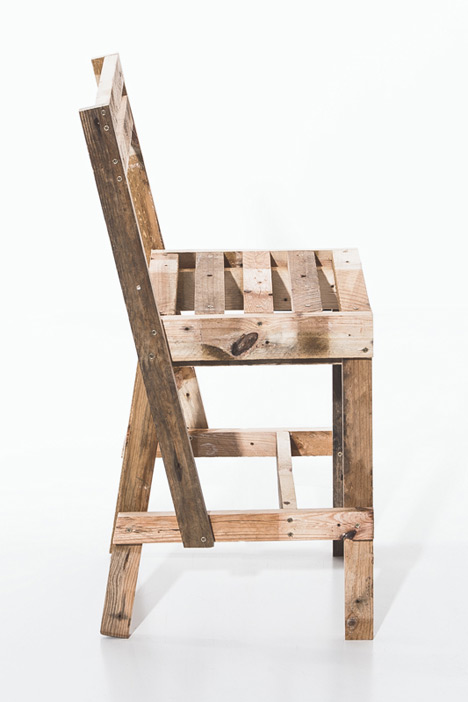
However, EPAL has no jurisdiction over young German designers Yanik Balzer and Max Kuwertz, who recently sent us an upcycling project in which they transformed a Euro pallet into a set of three chairs "with almost no waste of material."


Hit the jump to see results...
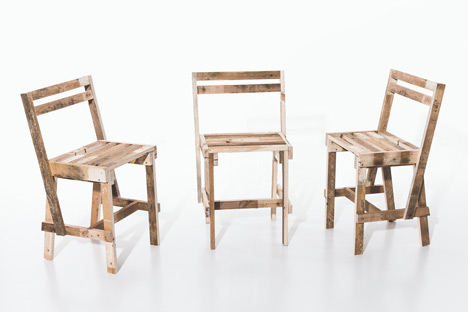

No word on the retail availability of the chairs, but considering that it looks easy enough to reverse-engineer them from the process photos, I can't imagine this is a commercial project... maybe Balzer + Kuwertz can follow up their 2012 Core77 Design Awards honor in the DIY category with the Pallet Chairs.
See also: Furniture as Street Art: DENNIS Design Center by Copenhagen's Bureau Detours
-
oFavorite This
-
Q9Comment
Directory Company Profiles

Core77
Industrial Design
Resources
Industrial Design
Resources
-
Core77 Directory
Find the Best Industrial Design CompaniesGo -
 Doris Dev
Doris Dev is a New York and Hong Kong-based product development agency with a proven track record of...
-
Delve
We are a multidisciplinary product innovation and development firm that brings bold ideas to market....
-
aruliden
Aruliden is a global design agency born in 2006. We are a collection of people who care deeply about...
-
Springtime design
Springtime is a creative force that develops exciting, sustainable and paradigm-shifting products, b...
-
The Metcalfe Group, Inc.
Located in the greater Cleveland, Ohio area, we are an experienced full-service product design firm ...
-
Acorn Product Development
Acorn Product Development is based in Silicon Valley with design centers in Boston, Denver, Los Ange...
-
Alternatives
We're a full-service branding and creative agency. We specialize in building brands, companies and o...
K
{Welcome
Create a Core77 Account
Already have an account? Sign In
By creating a Core77 account you confirm that you accept the Terms of Use
K
Reset Password
Please enter your email and we will send an email to reset your password.
Comments
Just go buy some decent S4S lumber. It will be cheaper in the end, unless your labor (and health) is worth $0.
I keep thinking I heard somewhere that using pallet wood for consumer products is hazardous because of treatments to flame retard and bug repel. Is this true?