StokkeAustad - "The Woods"; Image courtesy of Maria Larsson / Home in the Woods
It's always nice to be pleasantly surprised by a serendipitous visit to a strong exhibition, especially during a week when there happen to be dozens of events to visit. (With the launch of NYCxDesign, New York's annual design week was as supersaturated as ever, what with the ICFF expanding into Javits North and Wanted Design nearly overflowing with exhibitors.) As with Field and Various Projects' Here & There, an unassuming exhibition was well worth the visit, and even though most of last weekend exhibitions have been broken down, packed and shipped by now, Home in the Woods will remain on view at 29 Mercer St in Soho (albeit by appointment only).
However, unlike Jonah Takagi's effort, Maria Larsson's exhibition is brimming with New Nordic and Swedish Modern quality, including vintage pieces by Bruno Mathsson and Sven Markelius along with works of art and design. As the sole organizer of the exhibition, Larsson readily admits that her role went far beyond simply curating the exhibition: an architect by training, she oversaw the buildout of the gallery space, as well as the PR and marketing.
Vintage table and chairs by Bruno Mathsson; leather goods by Tigerklo; stool by Lith Lith Lundin
Although the Jacob K. Javits Convention Center is notorious for its rather unflattering industrial lighting fixtures, many of the exhibitors at the ICFF happen to design lamps and lighting for the appreciably more intimate settings of the home or office, where (thankfully) we spend most of our time. Here's a selection of some of our favs, including several new offerings from our friends at Rich Brilliant Willing, Brendan Ravenhill and Patrick Townsend.
The Gala Chandelier comes in a variety of configurations
Design agency smallpond looked to go big time for the inaugural NYCxDesign festival, entering the fray with the support of London's Designjunction. The new INTRO NY show was modest in the best way possible, a showcase of smaller, mostly non-NYC design brands in a well-lit, street-level space in the heart of Little Italy (there was audible din from a parade two blocks over when I visited on Saturday morning).
If on-site retail—a curated neo-utility pop-up shop—and refreshments seem to be par for the course at design shows these days, the backyard pop-up cafe was a nice touch (though I imagine it was rained out on Sunday).
In addition to furnishing the patio, San Francisco's Council made a strong showing with products new and old. They've brought a handful of young designers into the fold since the brand debuted at ICFF in 2007, including Chad Wright, who was happy to discuss the "Twig" chair that he designed for the brand.
The "Periodic" table by One & Co. was displayed front and center
Now in its fourth year, Noho Design District has taken on a few different permutations over the years, encompassing various pop-up exhibitions from a tiny Japanese butcher shop to a four-story lumber company headquarters (which happen to be on the same block, no less), reflecting both the changes within the neighborhood and the landscape of American design as a whole. Once again, our friends Jill Singer and Monica Khemsurov of Sight Unseen have masterminded a neighborhood-wide celebration of young and emerging designers. In addition to partnering with several co-conspirators such as Future Perfect and American Design Club, they've also curated the flagship Noho Next group exhibition, featuring 13 handpicked studios that comprise a showcase of design talent.
The exhibition took place over the weekend at Subculture, the event space in the basement of the 45 Bleecker Street Theater, which hosted Tom Dixon's London Underground exhibition last year. (I don't know if I'm dating myself with the reference, but I remember going to the Crosby Connection sandwich shop when they occupied the cafe a few years back...). Although it happens to be closing as I write this, hopefully our documentation can serve as future reference.
Although this year marks their first ICFF, PELLE Designs actually dates back to 2008 or so, when co-founder Jean Pelle developed the first Bubble Chandelier. She met her future business partner (and husband) Oliver about ten years ago at the Yale School of Architecture, and each went on to work for major firms before setting out on their own.
The "Quadrat" series of tables takes its name from the German word for "square"; Oliver left his native Germany to study architecture in the States
Thus, their debut collection consists of iterations on the designs: the Bubble Chandelier is now UL listed, and they've just introduced a long version (not pictured) for a total of nine different shapes and sizes (they've also taken an interesting step in making all of the items available to order through an online store).
Jean noted that they make and hand-carve the Soap Stones in their Red Hook studio
Stockholm's Konstfack is among the university design departments that occupy the removed North Building of the Javits Center this ICFF, a more manageable—albeit somewhat sparsely populated—exhibition hall in contrast to the main floor of ICFF. Despite—or perhaps because of—the largely theoretical curriculum of graduate programs in Industrial Design, the 11 first-year Master's candidates at Konstfack undertook a self-initiated project to actually make objects, which they first exhibited during Stockholm Design Week back in February. According to the Negative Space website:
What is a negative space? Can it be framed by something other than matter? Can a negative space be made tangible?
Ten explorations on the possible meanings of negative space showcasing new and intriguing perspectives. By shifting focus from matter to the space that it occupies, the designers have found new ways of working by investigating the relationship between objects and the surrounding space. Presented here are a series of individual interpretations of negative space, culminating in a fascinating interplay between form, memory, movement, light and time.
Insofar as the theme itself is intangible, the students took a broad range of approaches; even in the case of light, which might be considered an easy metaphor for space, the inspiration and execution varied significantly. Nevertheless, the overall aesthetic of the work is quite minimal, in keeping with both the theme and Scandinavian design language in general.
Unfortunately, the logistics of overseas travel and the tradeshow setting made for a somewhat attenuated exhibition—i.e. the convention center simply isn't the ideal context for exhibiting the highly conceptual work. (I find that the Javits Center, for all its cavernous, harshly-lit real estate, is something of a 'negative space,' if you'll excuse the pun.) In any case, the students were excited to be in New York—a first for many of them—and they were eager to share their work.
Daphne Zuilhof's "Spin" stool inspired friendly jealousy amongst her peers for it's packability. It takes it name not from the English verb but for the Dutch word for 'spider,' where its collapsible legs delimit a volume that is a usable space.
Remember the useless machine from a couple years back? You know, the device with a switch that activated an arm that flipped its own switch? For better or for worse, I couldn't help but think of that paradoxical box when I saw Zelf Koelman's "Switch Candle"... which, ironically enough, is something like a useful version of the same. Bearing a crown of five tealights, the curious-looking object functions as a dimmable candle. I won't ruin it for you; just watch:
Koelman describes the "Switch Candle" as a comment on "how we perceive artificial light, how we interact with it and how we should not forget the amount of energy light needs to shine."
For ages we have put much effort in keeping on the fire at night to extend the day and keeping us warm and safe. Since the invention of electric light sources, I believe we lost track of how much effort and energy it really takes to keep us awake.
The problem with driving the same route, day after day, is that it becomes easy for commuters to stop paying attention. They know the route so well that they subconsciously tune out, ignoring signage both static and electronic, even when the latter is flashing danger warnings in big, orange letters.
Needless to say this can have deadly consequences, and the authorities in charge of Australia's Sydney Harbor Tunnel decided to do something about it after the following incident: "We had a fire in the tunnel," explains Harbor Tunnel GM Bob Allen, "motorists ignored the warning lights and signs and continued driving towards the fire. These drivers exposed themselves to smoke and toxic fumes from the fire and then to compound the situation they turned around (in a one way tunnel) and drove back out of the tunnel against incoming traffic."
Through a government-led R&D program, Tunnel administrators were able to contact Laservision, a creative technology firm that designs architectural lighting, permanent attractions and special events primarily for the entertainment industry. They teamed up with pump manufacturer Grundfos to create a HUGE stop sign that is impossible to ignore: It seems to materialize out of thin air, directly in front of your car.
The Softstop, as it's called, utilizes a combination of pumped water and light projection. Watch it deploy:
Kvadrat Soft Cell panels line the entrance of the Moroso showroom
Celebrating Patricia Urquiola's first textile collection for Kvadrat, a feast of the senses was organized at Moroso's Milan showroom during Salone. Entering through a hallway lit with the dynamic glow of Kvadrat's Soft Cell panels, guests were welcome into the main showroom where rotating columns of embroidered fabrics were hung around the circumference of the space.
The Revolving Room honored a spirit of collaboration—between Urquiola, Moroso, Kvadrat and Philips—as a showcase of the myriad possibilities for textile application. The Urquiola-designed Kvadrat collection was the filter on the acoustic lighting panels, an embroidered skin on the rotating architectural columns, the fabric on Moroso furniture and a material transformed into bowls and inspiring food design by I'm a KOMBO for the communal table.
Kvadrat Soft Cells are large architectural acoustic panels with integrated multi-colored LED lights. These "Luminous Textiles" provide an ambient glow of light filtered through the textures of Kvatdrat fabrics. The modular panels are based on a patented aluminum frame with a concealed tensioning mechanism which keeps the surface of the fabric taut, unaffected by humidity or temperature.
The magic of the panels lies in Philips' LED technology which allows architects to control content, color and movement projected from the panels. The Kvadrat textiles provide tactility and sound absorption qualities even when the Soft Cells are static.
Core77 had an opportunity to speak with Urquiola on the collaboration with Kvadrat on the occasion of the collection debut. As the first designer to create a collection for the Soft Cells panels, we were interested in learn more about the process of designing across different mediums and working with light.
From left to right: Anders Byriel, Patricia Urquiola, Patrizia Moroso
Core77: This is your first time designing textiles for Kvadrat. What was your design process like and how was it different than designing furniture?
Patricia Urquiola: We worked in two ways. The first process started with the idea of "applying memory," to create a fabric that looks like its been worn with time. This fabric will not get older in a bad way because it is already "worn." The passage of time will be good for contrast.
The other idea was to work with digital patterns. We have been working with ceramics as part of my research in the studio for a long time. Part of these patterns were in my mind as we were searching for new tiling designs. I am working with Mutina, where I am the art director, and we're trying not to work in color—exploring bas relief and a treatment of the tiling.
One pattern is a kind of matrix—its kind of a jacquard. We're working with a classic technique in a cool wool, but in the end, you have this connection with a digital world. The contrast of the jacquard is sometimes quite strong and sometimes more muted—you can see and then not see the matrix.
And then there was the possibility to work velvet—opaque and quite elegant. We use a digital laser cut technique. They are patterns but not. They give an element to the fabric but they are still and quiet.
These are digital techniques but the process to create all three patterns was quite complicated. I'm happy because we explored three complex processes but they turned out amazing.
After she graduated from Syracuse University in 2005, Christine Price Hamilton spent several years working as a project manager/designer at a residential architecture firm before setting out on her own—or rather, as one of the independent studios at Fringe Union in Somerville, Massachusetts. Since 2011, she's been developing the Tesselight, as well as her freelance architectural practice, with the support of her fellow Fringe members.
Launched last week, the collection of pendant lighting fixtures are made from delicately assembled translucent paper that has been "sealed with a proprietary flame-retardant and stain-resistant coating, silkscreened by hand to achieve a perfectly smooth, satin finish."
The paper is fed through a traditional windmill press equipped with our custom wood block dies. As the paper is fed through the press, the dies stamp out a series of flat shapes that together create the pattern for each Tesselight. The flat pieces then go to the worktable, where they are folded, curled and sewn by hand into a series of triangular tiles. The tiles are joined to create a spherical shape so strong that it supports itself, no inner frame necessary.
The "Atom," pictured above and at top
We had the chance to talk to Hamilton about bringing her project to life.
Core77: What inspired you to create Tesselights?
Christine Price Hamilton: Through an admittedly nerdy obsession with Buckminster Fuller, I became fascinated with fractal geometry and the Platonic solids. I was curious to see what kinds of patterns would emerge if the faces of those solids weren't strictly flat and linear, and it seemed like the pliable and translucent properties of paper made it the ideal material to render those patterns most dramatically. I was really just experimenting. I made the first set of tiles without having any idea what the end result would look like, or even that it would be a light fixture. That first experiment became what is now called the Stella pendant.
I imagine it took some time to refine the product and process behind Tesselights. What were some of the challenges you faced, and what solutions did you arrive at?
The biggest challenge so far has been figuring out how to pack and ship the fixtures. Each curve of paper is held in delicate tension by a single thread. Prolonged pressure on the fixture—even from packing peanuts—will squish and warp those curves, ruining the overall symmetry.
Ultimately, the best solution was to use the laws of geometry to our advantage. Tesselights are now packaged using a single chipboard insert which, through a series of voids and folds, mimics the edges of the fixture's form and squeezes gently between each tile, effectively suspending the fixture inside its box.
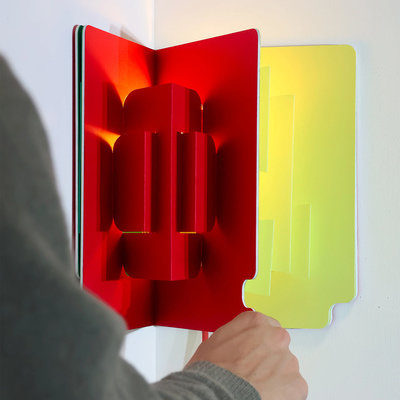
Lumio is a lamp that unfolds from a book. Simply open the cover to turn it on, the further you open the cover the brighter it gets. Sounds very simple, yet the design process was nothing but.
The journey started about eight months ago when I joined TechShop SF. I came in with the ambitious idea of creating a modular house with built-in furniture that you can fold flat to fit into your car. It's the same basic concept of a lunchbox: different parts of a meal packaged in a portable container. Except that it's a home-in-a-box that you can carry around and pop open easily.
My vision was to build a modular home for the modern nomad with all of the conveniences we are accustomed to. It didn't quite turn out the way I envisioned it, but through that design exploration, I ended up with a modified version of the same design concept, on a much smaller scale.
What does a foldable house have to do with Lumio? Although they share the same underlying design principles of a folding structure, physically they are nothing alike. Lumio was created out of necessity because I didn't have the resources to build a working prototype for the folding house. I had to adapt my idea and scale it down into something more manageable.
I had these paper models and sketches of the folding house in my Moleskine sketchbook. It dawned on me one day that a book would be a great way to package this idea of a collapsible light fixture: it's compact, it has a visceral connection with the idea of a book as a "source of illumination," and it has that unexpected element of surprise.
We always think that innovation happens when you have all the freedom and tools you need. In my case, it came together out of limitation. I was able to make the best use out of what I have.
Photo of Moleskine study model
I arrived at the concept for Lumio around September 2012. My first prototype was cobbled together out of folded paper inserted into the cover of my hardcover sketchbook. It was rough, but it was a good starting point as a proof-of-concept.
Designer Alexander Lervik is pleased to present Lumière au Chocolate, his latest project in the Lervik 100 collection, which he is presenting at this very moment in his current home of Stockholm, Sweden (the opening is tonight, February 4th, from 6–10PM at Galleri Kleerup). Produced by Scandinavian LED specialists SAAS Instruments, the uncanny chocolate ark belies a latent luminosity:
The Poetry of Light chocolate lamp, unlike other lamps, is completely dark when you first turn it on, mimicking light spreading along the horizon at sunrise. The heat from the lamp causes the chocolate to begin melting, and it takes several minutes for the first rays of light to penetrate. Holes soon form and as the light grows the chocolate melts. The material and structure of the lamp are the result of pure curiosity. Alexander Lervik wanted to explore the possibility of creating a contrast to light, i.e. dark. The shape of the lamp has been devised based on extensive testing involving the melting process.
If you're not familiar with the work of Kimou Meyer, a.k.a. Grotesk, we recommend checking out his excellent 2010 monograph. But even those of you who have never heard of the Brooklyn-based graphic designer ought to appreciate a recently-launched edition he has created for Case Studyo of Ghent, Belgium.
Limited to an edition of 23 (after Jordan, we hope) plus four artist proofs, "6FT - 6IN" is a baller lamp that is distinctive for its "blocky sneaker feet, as not only a signature Grotesk output, but also a design incubation decades in the making." Contrary to the height given in its name, the lamp measures 75cm (30 in.), or just under half the height of Mugsy Bogues, it's clearly intended to be a table lamp, featuring a cylindrical abat-jour set on skinny "string bean" legs are more Kevin Durant than LeBron. These minimalist components serve to underscore the unexpectedly playful base, featuring a classic Bulls color scheme.
Last week, I took issue with the plain rectangular box that served as the packaging for Taylor Simpson's MONIKER bicycle handlebar concept. Here, it serves as a remarkably felicitous concept: the custom packaging for "6FT - 6IN" resembles a giant shoe box—it's hard to tell from the photos, but I imagine it's upwards of three feet long—executed in custom screenprinted wood. It's a veritable triple-double of brilliant design: ten points for style, ten points for substance, plus another ten for packaging.
It's hard to believe the Times Square ball that NYC drops every New Year's used to be a five-foot affair (above) made of wood, iron and incandescent bulbs. Now, of course, it looks like this:
The iconic sphere ballooned to 12 feet in diameter, like it's chasing Indiana Jones. It also weighs a whopping 12,000 pounds, covered as it is in 12,256 Philips LED bulbs that can change color. It's also getting greener, as you'll see in the video below:
It's not the "improved chromatic yield" and the technical elements of iGuzzini's Pixel Pro recessed LED ceiling light that caught our eye; it's the thoroughly thought-out design by Massimo Iosa Ghini, the famed architect and designer.
To start with, Iosa Ghini ensured the form was beautiful in all 360 degrees, even the elegant blades of the heat sink that only the installer would get to appreciate. The installer would no doubt apppreciate the ease of his job as well, as the entire unit pops into place and locks in via two latches. (And yep, it's compatible with legacy diameters, so you don't have to buy a new hole-cutting saw.) Maintenance, too, is simplified by the easily-removeable cooling fan and reflector.
Iosa Ghini didn't forget the end user, of course; the fixture can easily be rotated downwards with 75 degrees of travel, turning the lamp into a spotlight. Check it out:
Originally hailing from Poznan, Poland, where he completed his undergraduate degree at the University of Fine Arts, Marcin Pogorzelski is currently working towards his Masters at Sweden's renowned Konstfack. His latest projects certainly express a bit of Scandinavian influence, both for their simple elegance and fluent execution.
First up, the belTable is a bit more Home Depot than IKEA (in a good way): Pogorzelski set out to "minimize every part of table and make it even easier to put together after unpacked at home." It consists of just four parts: the tabletop, legs, pegs and its signature element: a heavy-duty nylon belt.
As you might have guessed, the belTable requires no screws or glue for assembly. The belt also doubles as an ad hoc storage solutions for newspapers and magazines, as illustrated in the images.
Travel a lot? Keep weird hours? Sleep is a common problem for designers, especially those with tight deadlines and an international client base. Every designer I know has their own secret remedy for managing sleep schedules and jet lag, whether that be diets or types of music or forms of exercise.
Enter the Retimer. A special set of glasses (that can fit over regular glasses), the Retimer beams light into your eyes to help you adjust your body clock. With a simple jet lag calculator, a frequent traveller can develop a simple schedule for wearing the glasses to help him or her adjust swiftly. Other possible uses? Night workers, insomniacs and those suffering from seasonal affective disorder can all stand to benefit.
But if glasses can be effective, why not just turn on the lights? When I travel, I use the lights in my room and work studio to help me adjust quickly. When it's bright out, I use an eye mask to manage my eyes' exposure to light. This is useful because light can creep in through windows and cracks in the door. But darkness? Not as much.
Early iterations of LED-based task lamps welded the bulky armature of a spring loaded swing arm with an airy plane of illuminating diodes. Compared to the fragile bulk of an incandescent, the form factor of the arm rarely did the new technology justice.
Consequently when we first saw the loose and spindly form of the Harvey lamp by David Oxley, we were intrigued. The product specifications state that the featherweight arm comes it at just 0.3 kilos. (that's about 10 ounces to a Yank), making the five pound base seem like a ton, though I'm sure he's done the maths on the balance.
More interesting to us is the promise of a novel joint technology allowing full freedom of movement using magnets. Perhaps when supporting that little weight, you no longer need springs. Unfortunately, the schematics didn't show a cross section of the joint, so those details weren't illuminated. At 99 quid ($159), we were happy to Kickstart the project, just to receive a lamp and find out.
Designer Richard Clarkson's brings a highly detail-oriented approach to his consistently well-executed work, whether it's crafty, comfy or concept-y. As the inaugural term of SVA's Products of Design program draws to a close, Clarkson is going out with a bang with "The Cloud," a "semi-immersive lightning experience [that] introduces a new discourse for what a nightlight could be." The gauzy exterior—made from hypoallergenic fiberfill felted to an armature—of the miniature cumulus conceals its internal electronics, including lighting elements and a speaker, which are activated by controls on the Cloud's base.
In his own words:
Advances in physical computing and interaction design hardware over recent years have created a new breed of smartobjects, which are gaining more and more traction in the design world. These smartobjects have the potential to be far more interactive and immersive than ever before. And what is exciting is that it's becoming increasingly easier and cheaper to become a part of this new kind of making, with DIY and hacker community initiatives such as Maker Faire, Instrutactables and numerous others. This project aims to capture the essence of this kind of designing—where ideas and process are shared for others to use and expand upon.
The animated gif can't quite steal the thunder of the video (after the jump)...
As the founder and principal of SONIC, Klaus Rosburg develops consumer electronics and structural packaging, but he's also been known to combine these two specialties in one-off lamps from readymade and discarded objects. (He's previously crafted a chandelier from coathangers and a pendant lamp from clothespins, among other bespoke objects.)
After collecting packaging seven years' worth of packaging from his wife Cindy's contact lenses, he'd finally amassed enough of them to make his latest work, named after the Latin for jellyfish:
Visiting the current LIGHT show at the Museum of Natural History in NY and you might have seen the jellyfish with fluorescent molecule, the green fluorescent protein, or GFP. Touch these jellies, and they flash green light.
Fascinated by the glow and weightlessness, the Brooklyn-based designer drilled, arranged and connected, disconnected and rearranged hundred of the cases to capture the look and mystery of these sea creatures. 500 rivets and a few blisters later, the chains of cases were transformed into Cnidaria, Creature of Light.
Remember the LIFX, the wi-fi-enabled smart LED bulb? While its Kickstarter funding period ended two weeks ago (well past its $100,000 target with $1.3 mil in pledges), there's no word on when production will begin; on November 12th the LIFX team wrote that "It's not possible to make final [production decisions] until we perform detailed thermal modeling and standardized measurements of light output, color rendering index, white balance agility, etc."
In the meantime Philips has been stumping for their own wi-fi-enabled, color changing offering, the Hue bulb. Interestingly, one of their marketing points is that you can select the output color (using an iDevice) via a method that will be familiar to Photoshop eyedrop tool users. Check it out:
Being the corporate giant that they are, Philips has adopted an interesting marketing technique: They've chosen to make the device available only through Apple Stores (both online and brick-and-mortar), taking preorders now and shipping in several months. At 200 bucks for a three-bulb starter pack the things ain't cheap, though they're about the same cost as the LIFX's initial $69 Kickstarter buy-in.
Rogue retailers, by the way, are re-selling Hues through Amazon at an usurious $100 per bulb; it remains to be seen if Philips will crack down.
On LIFX's Kickstarter comments page, some expressed skepticism about this project; but internet trollage aside, if Philips has thrown their weight behind a similar concept, you can bet they've concluded there's a market. Now we'll have to see whether it's David or Goliath that wins this early battle in the smartbulb war.
When I moved in my new apartment, the last owner had left [an IKEA] Rigolit lamp in the middle of the living room. An object that looks like a fishing rod holding a big paper cloud. The lampshade was ripped everywhere and Scotch tape was holding it together. This huge volume was always in the way and we kept bumping our heads into it. One day, I had enough and decided to buy a new lampshade to replace the paper one. Everything was either too expensive for me or extremely ugly. Also, the closest IKEA was an hour away... by bus.
What does a designer do in such a situation? He makes! A few hours later, thanks to affordable 3D printing, a unique lampshade was made. I couldn't stop there, so I designed 2, 3... 12 different ones, using always the same shape and changing only the color and the texture. They take between 4 and 12 hours to print, use absolutely no support material, weight between 50g and 100g and cost less than $5 to print.
As in his "Project RE_," Bernier's approach captures the spirit of the Fixer's Manifesto to a tee, revitalizing a superficially damaged object with ingenuity, a bit of elbow grease (and a spool of ABS, of course).
If its mundane (yet accurate) name somehow belies its understated form, it is precisely because Alexandra Burr's "2×4" lamp is a successful exercise in brevity.
This pendant light is made from a simple 2x4, whitewashed to make it slightly more precious. Suspended by mono filament, it appears to float. An LED strip is hidden by a frosted glass lens. And a decorative red cord loosely stretches to the ceiling.
The Brooklyn-based Burr—an architect by training—is duly "material and process driven, exploring the technical challenges of the production and manufacturing process while striving to produce beautiful objects and spaces with an inherent simplicity of form." Thus, the execution of her pendant lamp is radically different from previously-seen trompe l'oeil table lamps, which achieve the magic of levitation through magnetism.
Nevertheless, the perspicuously antiseptic setting of the photographs is entirely too perfect for the minimalist lamp, and it's difficult to imagine how it might look suspended in context. While there's no denying the 2×4's elegance, I suspect that the fixture demands similarly unassuming decor (if Sébastian Cluzel's "Culinary Landscape" is too obvious, I could also see "2×4" hovering over, say, LucidiPevere's "Boiacca" table).
When it rains, it pours: Zürich-based design studio Micasa LAB first showed up on our radar four weeks ago, with the iRock rocking chair, followed by the Cocoon1 just a week later. This week sees the launch of the "Nebula 12," which can only be described as a WiFi-enhanced combination of a lamp and a fog machine, a device that gives new meaning to "cloud computing."
The Nebula 12 gathers meteorlogical data via the Internet (specifically, a weather service called MetOff) and translates that into atmospheric conditions indoors: "the Nebula 12 can change in colour and brightness and thus can be used as a variable source of light for romantic evening meals, when doing homework, when reading or just chatting... wake up to a flooding yellow light on a sunny day, or below a real cloud on that overcast winter morning." The artificial cumulus is conjured from thin air though "some peculiar techniques, liquid nitrogen, WiFi, and high-powered vacuum suction."
That last bit might obliquely underscore the device's passing resemblance to a certain article of paraphernalia, but the first thing that came to mind, for me, was actually a birdfeeder (not least because it hangs from the ceiling). In this sense, the Nebula 12 is essentially the inverse of the Nest learning thermostat: instead of adapting to user behavior (as the Nest does), Micasa LAB's concept is operates based on the forces of nature—sublimated into an attentuated household weather pattern:
In the standard mode, Nebula 12 predicts the weather for the next 48 hours. A threatening low-pressure area is announced by a red cloud, and sunshine is shown in yellow. At the same time, the user can adjust the settings and define the source of information themselves. And the best is: regardless of how dark the cloud is, Nebula 12 never brings rain. At least, not within one's own four walls.
Toronto-based design group Castor gets called a lot of names, especially sustainable—that S word whose egregious misuse irks us so. Not that Castor isn't sustainable, there are just so many better ways to describe them. Founders Kei Ng and Brian Richer say their furniture and lighting collection has a "sense of irreverence," a sentiment echoed by their highly irreverent and really kind of awesome head shot, above.
As far as their actual products are concerned, we suggest descriptors like recycled, or perhaps upcycled. The short doc, Castor is French For Beaver (it is—we checked), recently made by Carling Acthim and Lana Mauro, takes a closer look at two of Castor's best known lighting designs, the Tank Light and the Tube Light, both of which repurpose cast off materials like old fire extinguishers and burnt out halogen tubes and turn them into hanging light fixtures whose final form is completely removed from their previous lives.
Upon a little digging, I was surprised to find that the project dated back to April 2011. Noting that his current company Souda, which he co-founded with Isaac Friedman-Heiman, was founded this year, I inquired about the 20-month gap. Kasperbauer responded at length:
The Chandelier was originally made as a school project of mine a few years ago. Isaac and I, along with our third studio-mate Luft Tanaka, just graduated in May from Parsons School of Design for product design. I had been shopping around for commercial spaces during the last month of school and we signed a lease on our studio space on June first. We are just in the process of launching our first line, which includes a few revamped pieces that we had designed in the past along with a few new objects (and a number of items still in development). While the Bubble Chandelier was originally prototyped a few years ago, it has just now finished its first production run. The relationship with SURE WE CAN is something that came about once we started looking to produce the fixture.