
e
Say Do Svidanya to the Portyanki: Russian Troops to Get Sock Upgrades
Whether Axis or Allied, there wasn't any army that had it easy during World War II. But I just learned an astonishing fact that hadn't come up in any of my go-to WWII history books: The Red Army did all of their fighting without wearing socks.
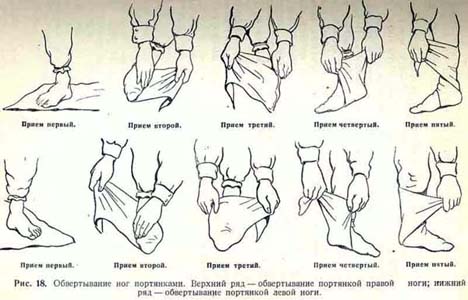
Which is not to say they had nothing between their feet and their boots. Russian soldiers were issued portyanki, which are cotton or flannel rectangles of cloth not much larger than a handkerchief. Troops were taught to wrap them around their feet, as seen below, before donning their boots.
If you're wondering why there's color footage of someone doing this, the surprising fact is that portyanki have been a Russian army staple until this year. Although they began phasing them out starting in 2007, it was just this month that Russian Minister of Defense Sergei K. Shoigu issued a call to replace them across the board with proper socks.
The big question is, why did they use these? The answer is manufacturing. While it's well-known that Russian manufacturing might flooded the battlefields, during the second half of the war, with an overwhelming number of T-34 tanks, that industrial largesse did not extend to sock factories. With a finite amount of manpower (womanpower, more than likely) on the home front, and the manufacturing ease of producing cloth rectangles rather than knitted, fitted socks, the decision was made to stick with portyanki.We say "stick with" because portyanki, or "puttee" as they were known to Western armies, were in fact what British, American, Chinese Nationalist, Italian, and French troops were all wearing in the first half of the 20th century. The Brits starting using them in the 1890s, and in fact the name "puttee" is an Anglicization of the Hindi word patti, or bandage. The puttee/patti was more like a boxer's handwraps than a handkerchief, and some Russians were issued these as an alternative. Here's how this latter variant goes on:
Unbelievable. I'll never complain about unlacing cumbersome boots again.
via the at war blog
-
oFavorite This
-
Q3Comment
Directory Company Profiles

Core77
Industrial Design
Resources
Industrial Design
Resources
-
Core77 Directory
Find the Best Industrial Design CompaniesGo -
4design
4DESIGN | www.4design.com.au | +612 9280 4454 4DESIGN are a team of focussed, talented, motivated a...
-
DesignThink, Inc.
DesignThink is a full service product development group focused on defining, developing and deliveri...
-
Acorn Product Development
Acorn Product Development is based in Silicon Valley with design centers in Boston, Denver, Los Ange...
-
andesignlab
ANDESIGN is an industrial design consultancy based in Orange County California and Austin Texas. AN...
-
DesignStein Studios, LLC
We are a team of industrial designers focused on developing products that are intended for tooling a...
-
Sundberg-Ferar | Product Innovation Studio
Sundberg-Ferar, a product design firm, helps the world's leading durable product companies to turn c...
-
 Tactile
Tactile is a product and UX design firm founded in 2004. Blending physical and digital design, we cr...
K
{Welcome
Create a Core77 Account
Already have an account? Sign In
By creating a Core77 account you confirm that you accept the Terms of Use
K
Reset Password
Please enter your email and we will send an email to reset your password.
Comments
Truth is, while manufacturing really was a serious issue a century or more ago, portyanki had way more serious advantages over socks: hygiene and sturdiness. Meant to be worn with rough high boots (cheap synthetic leather boots in soviet army), they don't tear down in a few days like socks do, they really protect feet in such user-unfriendly footwear, they withstand dampness way better and they are washed just once a week. Not the best smell possible, but imagine fighting or marching or entrenching in dirt, rain and snow for days without changing your socks.
Ah, yes, and they were meant to be used with talcum powder as a cheap hygienic measure.
Also you may read something on puttees. They were used through both world wars by some armies. Same idea, other body part.