
e
IDEO and Steelcase update the classroom desk

If you travel back in time and show a student from the 1950s an iPad or Twitter they'd have a tough time making sense of it; show them a classroom desk, though, and they'd see it's changed little.
Steelcase's IDEO-designed Node chair aims to change that, with a modern re-fresh of the schoolroom desk-chair combo.
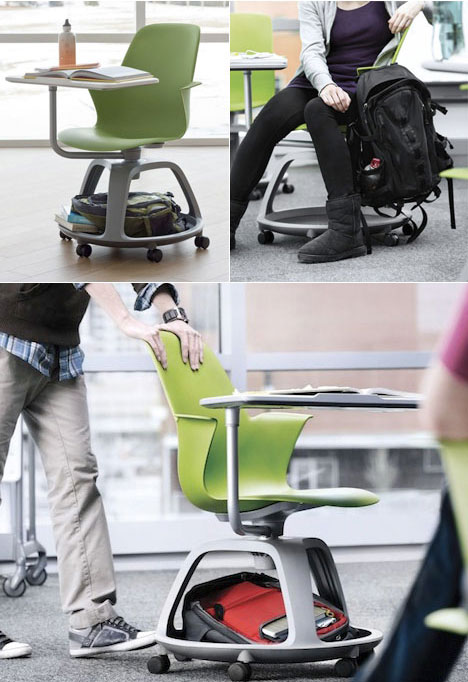
Its most significant feature is the casters that allow students to pivot and swivel, following dynamic presentations, or quickly move the desks into circles or conference tables depending on the task at hand. Off-the-floor storage is provided underneath the chair, and backpacks can also be hung from the armrests for quick access to materials. And the generously-sized desk surface is meant to hold an entire laptop without any precarious cantilevering.
Steelcase and IDEO have even taken the physical receiving of the Node into account: Shipped in three pieces, the Node can be assembled in 30 seconds without tools!
Read more about the Node and the methodology behind its design here.
via fast company
-
oFavorite This
-
Q9Comment
Directory Company Profiles

Core77
Industrial Design
Resources
Industrial Design
Resources
-
Core77 Directory
Find the Best Industrial Design CompaniesGo -
 Bruce Mau Design
BMD is a multidisciplinary brand and design studio. At BMD, we are here to move organizations forwar...
-
Artefact
Artefact is a strategy + design firm. Design is powerful. It determines how we experience life, and ...
-
Formation Design Group
Formation is a product design + development company focused on human centered design innovation. To ...
-
Studio RedEye, LLC.
Studio RedEye is a Brooklyn-based industrial design studio that helps brands bring bold, manufactura...
-
Acorn Product Development
Acorn Product Development is based in Silicon Valley with design centers in Boston, Denver, Los Ange...
-
Hatch Duo, LLC
Founded by an award-winning team with over 20 years of combined product design experience, Hatch Duo...
-
Datum3D Product Development
Datum3D is a one-stop shop product development company located in the Greater Boston Area. Founded i...
K
{Welcome
Create a Core77 Account
Already have an account? Sign In
By creating a Core77 account you confirm that you accept the Terms of Use
K
Reset Password
Please enter your email and we will send an email to reset your password.
Comments
A: Durability.
#1 The Casters look like 2nd class $20 office chair plastic. Perhaps metal or rubber could take the test of time better.
#2 The rotating table top could really use a little beefing up, kids will likely be laying on them at some point.
B: Human Factors.
#1) The Casters and table top, should have some way to lock. Either after a certain weight load is placed on them, or a click that would engage at least two wheels at once. Why? Imagine anyone standing next to a chair wanting to take a little load off by leaning on it.
#2) I remember my backpack habitually being to tall for under my chair. I wonder how the loading of this will affect a chair while empty of student. (but were all going digital right? no need for backpacks when we just carry our tablets.
The casters are actually a problem, potentially. I can just see harried teachers having to deal with kids rolling their desks around the room, just wiggling them back and forth -- or even playing bumper cars with them. It depends on the inertia of the casters in question, I'm sure. But even a typical office chair kind of roll could be disruptive in class.
The noise issue when desks are rearranged has been handled by teachers already with the tennis ball hack:
http://www.visuallee.com/weblog/images/tennisballs.jpg
Could there be a solution more like that? Allowing quiet rearrangement without actually turning the desks into vehicles?No one has solved it yet.