
e
Strong Images Comprehensively Depict "The Ruins of Detroit"
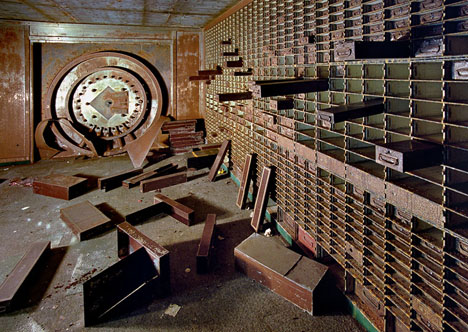
Photographer Kevin Bauman's "100 Abandoned Houses" project showed the empty domiciles of Detroit, but French photographers Yves Marchand and Romain Meffre have gone further: Their photo book The Ruins of Detroit is far more chilling because it displays the disintegration of livelihood at every level. It's one thing to see empty houses, but Marchand and Meffre's shots show abandoned banks, train stations, dentist's offices, police stations, ballrooms, hotels, schools, churches and more.

Over the past generation Detroit has suffered economically worse than any other of the major American cities and its rampant urban decay is now glaringly apparent during this current recession. Yves Marchand and Romain Meffre documented this disintegration, showcasing structures that were formerly a source of civic pride, and which now stand as monuments to the city's fall from grace.

"Ruins are the visible symbols and landmarks of our societies and their changes, small pieces of history in suspension. The state of ruin is temporary by nature, the volatile result of the end of an era and the fall of empires. This fragility, the time elapsed but even so running fast, lead us to watch them one very last time: being dismayed, or admiring, wondering about the permanence of things. Photography appeared to us as a modest way to keep a little bit of this ephemeral state."

Alas, while people left Detroit because work was in short supply, Marchand and Meffre's book is scarce because people can't get enough of it. Until publisher Steidl kicks off its fourth print run, The Ruins of Detroit is currently sold out.

-
oFavorite This
-
Q6Comment
Directory Company Profiles

Core77
Industrial Design
Resources
Industrial Design
Resources
-
Core77 Directory
Find the Best Industrial Design CompaniesGo -
Kritzer Design Studio | KDS
Based in Seattle, WA. Kritzer Design Studio | KDS specializes in providing award winning industrial ...
-
Springtime design
Springtime is a creative force that develops exciting, sustainable and paradigm-shifting products, b...
-
 Shark Design
Shark Design is a full service product development company with offices in Hong Kong, Shenzhen (Chin...
-
Tandem Product Design
With a stellar record of design and engineering successful products with World Class brands since 20...
-
Pushstart Creative
What is your future in a connected world? We create impactful strategies and build beautiful connec...
-
Anvil Studios, Inc
Anvil Studios is a product design firm for the real world. Anvil is Treasure Hinds and Greg Janky. ...
-
Fahrenheit Design
Fahrenheit is an award-winning product design and innovation firm based in Austin, Texas. Since 2002...
K
{Welcome
Create a Core77 Account
Already have an account? Sign In
By creating a Core77 account you confirm that you accept the Terms of Use
K
Reset Password
Please enter your email and we will send an email to reset your password.
Comments
The expectation of lower prices, no matter what, is a big piece of this: raw materials cost what they cost but with advent of containerized shipping and the internet, things can be made wherever the labor is cheapest. That means jobs are exported and cities based on manufacturing are hollowed out.
As for Boeing leaving Chicago, why wouldn't they? They left Seattle without looking back. Maybe if they had competition, they would have to, you know, compete for sales rather than cheaper labor and tax subsidies.
Consolidation is antithetical to capitalism and markets and that's what we have. Two commercial airliner makers in the world: does that make sense? In the US, how many national banks? Four. How many national telcos? From the seven baby bells and Ma Bell, we're down to four. Railroads, carmakers, cable networks, etc.: less competition, more anti-competitive behavior.
I don't think the NLRB is to blame here.
Chicago is on its way! The news keeps it secret but businesses can't leave this state fast enough.
Politicians and liberals just don't understand business. Why should they? They are entitled, after all. And so pride comes before the fall.
Baltimore is almost worse, but bombed out row houses have nothing on the infrastructure of an entire industry.