
e
Sketchnotes 101: Visual Thinking
 Sketchnotes by Craighton Berman.
The recent rise of the "visual thinking" movement in business borrows from the natural ways designers work—using sketches to explore and express ideas, manipulating complex systems of thoughts on sticky notes, and using rough visuals to make sense of the world. Humans are, of course, wired to be visual thinkers from birth, so it's only natural that people are attracted to these tools, and the power they have to help solve problems and explore opportunities.
In the long list of tools one could use for visual thinking, sketchnotes are one of the most exciting. Simply put, sketchnotes are visual notes that are drawn in real time. Through the use of images, text, and diagrams, these notes take advantage of the "visual thinker" mind's penchant for make sense of—and understanding—information with pictures. Often these notes come out of lectures or conferences, and have gained a lot of attention and interest in the past few years when people post scans of their sketchbooks from events like SXSW or various design conferences for the whole internet to see.
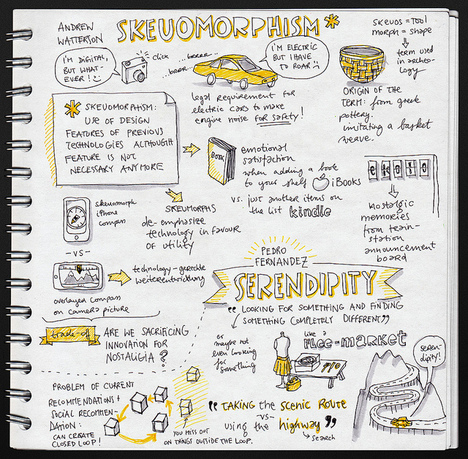 Sketchnote by Eva Lotta Lam
This kind of note taking has an obvious appeal for both the coverage of the event as well as the aesthetic quality of getting a peek inside someone's sketchbook—but good sketchnotes are actually much more than a set of beautiful doodles.
Sketchnoters aren't reporters, information designers, or illustrators. They're actually all three at once. This form of rapid visualization forces you to listen to the lecture, synthesize what's being expressed, and visualize a composition that captures the idea—all in real time. A musicians' "circular breathing" for the Moleskine crowd.

Instead of recording what's being said verbatim, good sketchnotes capture the meaningful bits as text and drawings. Better sketchnotes use composition and hierarchy to give structure the content, and bring clarity to the overall narrative of the lecture. The best sketchnotes express a unique personal style and add editorial comments on the content—entertaining and informing all at once.
Sketchnotes serve a few purposes:
They're PERSONAL: They act as a visual journaling tool so when you attend a lecture, you can remember the bits of information and images that have meaning for you. Sketchnotes are also a great way to record your ideas and observations—these aren't reporter's notes, they're your thoughts and interpretation of the subject matter as well.
They're PUBLIC: Great sketchnotes create a "map" of the presentation that provides a visual summary for others to read and explore. More and more sketchnotes are shared online, giving people views into both the content that was being presented, as well as the point-of-view of the sketchnoter.
They're PRACTICE: Sketchnoting hones your skills in observation & listening, distilling and structuring information, creating narratives, and—of course—rapid sketching.
 Sketchnote by Mike Rhode
Consider sketchnotes to be the antidote for the age where lecture attendees only partially engage in the speaker's presentation while they Tweet the last quotable quip and check their RSS reader for the latest update on Engadget. The sketchnoter is focused, singularly engaged in what's being said, and is fully engaging their mind to shape something from that content on the blank page in front of them.
Next up: How to sketchnote.
-
oFavorite This
-
Q13Comment
Directory Company Profiles

Core77
Industrial Design
Resources
Industrial Design
Resources
-
Core77 Directory
Find the Best Industrial Design CompaniesGo -
 Ammunition
Founded in 2007, Ammunition is led by partners Robert Brunner and Matt Rolandson. Our work is create...
-
Agncy Design
Using design as a tool to reduce structural inequity. We work with teams and leaders to make the equ...
-
Formation Design Group
Formation is a product design + development company focused on human centered design innovation. To ...
-
Fresco Design
Fresco supports world-class brands with world-class design. Based in the Boston area, we provide est...
-
Studio RedEye, LLC.
Studio RedEye is a Brooklyn-based industrial design studio that helps brands bring bold, manufactura...
-
Bould Design
BOULD DESIGN is a strategic partner for bringing highly functional, beautiful and successful product...
-
DesignThink, Inc.
DesignThink is a full service product development group focused on defining, developing and deliveri...
K
{Welcome
Create a Core77 Account
Already have an account? Sign In
By creating a Core77 account you confirm that you accept the Terms of Use
K
Reset Password
Please enter your email and we will send an email to reset your password.
Comments
J Walters
http://wp.me/p1KbDr-dR
I would encourage the just-starting-out sketchnoter to not worry too much about what an outsider would gain from looking at your visual notes at first. As an artist, let what speaks to you land on your page - and trust it will be attractive in the end, as it was infused with your own artistic spark. Learn to trust your ability to gather the content before you worry about arranging it in a uber slick way.
So, looking forward to your next article on "how to sketchnote"
Kudos for a nicely-done article here! :^D
I'm a graphic recorder and facilitator...and I'm also one of those folks who does her sketchnotes (I call them VizNotes) in all sorts of colors. As Eva-Lotta shares, my notes and color-work are all done in real-time, never as a follow-up embellishment, and it's actually an integral part of my visual listening process: my color work serves to keep me focused on what's happening in the moment and act as a natural memory enhancer.
Basically, my process is to have the blank page, have my pens, and listen. What speaks to me from the content is what goes down on the page, and it organizes itself organically. (I never plan, sketch, or organize in advance.) When I take VizNotes, I capture the things I want to remember...unlike my graphic recording projects which cast a much broader net in order to serve as a group memory. And, as Craighton writes, my VizNotes are absolutely personal (my notes reflecting MY perspective of - and interest in - the subject matter), public (usually shared with others), and part of my visual listening practice. I can't not do them!
Thanks for this post, and the conversation thread! I'm very glad to have found it, and I'm looking forward to the next!
has much to do with this way of thinking/understanding/ and presenting...
http://en.wikipedia.org/wiki/Understanding_Comics
c3
thanks
The sketchnotes Craighton included in this post are actually all taken in real time during the talks, so no extra time 'wasted' afterwards to add embellishments.
I don't quite agree with you, when you say the goal of note taking is "to lay down the biggest amount of information on the paper in the least amount of time". I agree more with the idea of useful "synthesis" which implies that it is not about the quantity of notes you take, but the quality and the depth of engagement you have with what was said or thought.
By synthesing and condensing some of the content visually during a talk (or a 'thinking session'), I process, filter and interprete what was said in real-time, which helps a lot to absorb and remember the content.
Also, when I take visual notes, I am looking for big picture and/or themes only, and rarely the more granular points. I can also attest that sketchnoting, for me anyway, is not planned at all. It is dependent on what the speaker says, and I have never had a transcript of the talk before the speaker began.
I will say that it's taken me about two years to get to where I am, and I still have a lot to learn. The faster the speaker goes through their content, or the more information I want to capture, the more typographic (word-based) my sketches are. The more big picture the content is, the more my sketches are visual. Again, sketchnotes are dependent on the sketchnoter's purpose and style, and the speaker's content and pacing.
what i'm looking for when i make notes, is to lay down the biggest amount of information on the paper in the least amount of time, so it really boggles me how is it that people take the time to paint their doodles in multiple different colours and make all sorts of graphic styling. This to me defeats the purpose of the intimate act that is making notes about something. it seems planned, and that it was made only for it's visual appeal (which i will not deny).
it's either that or i'm really slow at taking notes = /
I'm a long-time Core77 reader but this is the first time I've commented. I love this idea and especially how you broke the purpose down into three key concepts--PERSONAL, PUBLIC, and PRACTICE. The fusion of especially the personal and practice are what I think is the most exciting thing about this approach to note-taking as a way to fuel ideation. The personal draws upon everyone's innately unique "voice" when it comes to sketching, while the practice hones our ability to think outside of the screen. Since digital tools are so essential to the practice of design today, I find that the more time we spend in front of a screen, the more limited our thinking and ideas.
I actually did a post for Print Magazine's blog (imPrint) on this very thing. I called it "Offline Thinking for Screen Workers" (http://imprint.printmag.com/web-design/offline-thinking-for-screen-workers/) and shared some examples from my own notebook. I think they're similar to what you've shared here.
Looking forward to the next installment!
- Chris