
e
The Nest Learning Thermostat

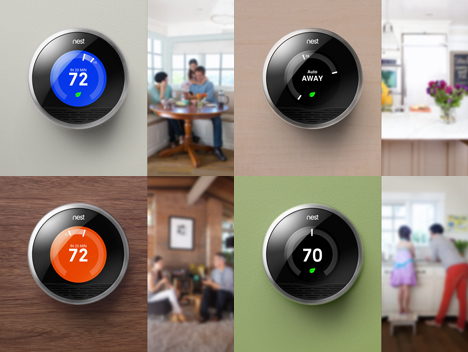
Today marks the launch of Silicon Valley startup Nest Labs' Learning Thermostat, a device that is exactly what it sounds like and much more: a thermostat that learns from user behavior to create a custom heating and cooling schedule. Company founders Tony Fadell and Matt Rogers—who spearheaded the design and engineering of the iPod, respectively—found it "unacceptable... that the device that controls 10 percent of all energy consumed in the U.S. hadn't kept up with advancements in technology and design."According to the U.S. Department of Energy and Lawrence Berkeley National Lab, the annual energy bill for a typical single-family home is approximately $2,200, with heating and cooling (HVAC) accounting for approximately half of the bill. The programmable thermostat, developed in the 1970s, promised to help people conserve energy, but 89 percent of owners rarely or never set a program (source: ACEEE, 2010). The devices are simply too complicated. In fact, Energy Star revoked its certification of all thermostats in 2009 when it became apparent that people weren't actually engaging with programmable thermostats to reach their proper functionality.
Nest addresses the programming problem through a combination of sensors, algorithms, machine learning, and cloud computing. Nest learns behaviors and preferences and adjusts the temperature up or down accordingly, making you comfortable when you're home and saving energy while you're away. Nest also provides people with tips and information to help them make energy-saving choices.
Thus, the Nest Learning Thermostat sets new standard for climate control: while the device learns continuously throughout its lifetime, the first week of operation is purely a schedule acquisition period. The UI/UX is vaguely iPod-like in its intuitiveness: rotate the (brushed aluminum) outer ring in either direction to adjust the temperature.


Wi-Fi connectivity allows for remote control via network devices—i.e. laptop, smartphone or tablet—as well as metrics and syncing with weather.

Along with requisite temperature sensors, the Nest is also equipped with activity and ambient light detectors so it knows when you're home, so a (secure) mobile app also allows for even remoter control.
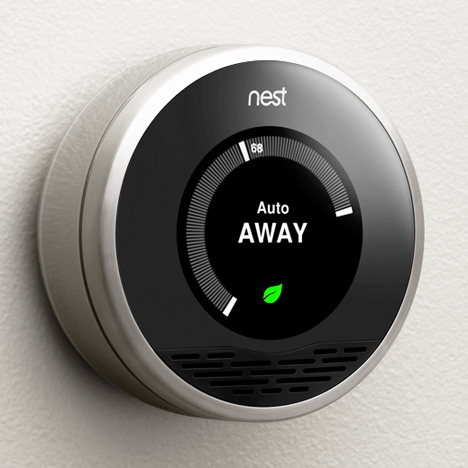

But the Nest doesn't just learn, it also teaches: "The Nest Leaf appears when you set a temperature that saves you energy—and money. The Leaf guides you in the right direction and helps you be energy-efficient."
On one hand, it's a brilliant real-life application of "gamification," at least insofar as it provides feedback based on input; on the other hand, it's a nice example of benign artificial semi-intelligence... until it becomes a terrifying example of megalomaniacal artificial intelligence (we're curious as to whether HAL was a reference point for the "glass eye" style design).

More broadly speaking, the press release struck me as an example of the Digital Age space race: identifying and bringing innovation to "spaces"—i.e. products or categories—that are lagging behind the current vanguard of technology and design. "Bill Campbell, Apple and Intuit board member and Nest advisor [says] "Under the leadership of Tony Fadell, the company is poised to make a significant impact on an industry that has been virtually void of innovation for the past 30 years."

Do any other heretofore neglected "spaces" come to mind?
-
oFavorite This
-
Q10Comment
Directory Company Profiles

Core77
Industrial Design
Resources
Industrial Design
Resources
-
Core77 Directory
Find the Best Industrial Design CompaniesGo -
 Bruce Mau Design
BMD is a multidisciplinary brand and design studio. At BMD, we are here to move organizations forwar...
-
Astro Studios
Astro Studios of California launched in 1994, and since then our multidisciplinary teams have design...
-
Zack Group LLC
Zack Group is an award winning brand & package design firm specializing in visual revitalization of ...
-
Alternatives
We're a full-service branding and creative agency. We specialize in building brands, companies and o...
-
DesignStein Studios, LLC
We are a team of industrial designers focused on developing products that are intended for tooling a...
-
Spatial Dynamics
Spatial Dynamics is a hardware product design and development agency located in Cambridge, Massachus...
-
RMT PRODUCTS LIMITED.
RMT PRODUCTS CO. , LTD. provide on-time delivery, high-quality prototyping and manufacturing . It i...
K
{Welcome
Create a Core77 Account
Already have an account? Sign In
By creating a Core77 account you confirm that you accept the Terms of Use
K
Reset Password
Please enter your email and we will send an email to reset your password.
Comments
http://174.129.132.250/home/2009/06/programmable-thermostats-energy-star-epa-save-energy-cooling-heating.html
When I bought the thermostat in our house, I followed the process most people do: I went to Home Depot and picked what looked like the best one. It certainly wasn't the cheapest. The one I chose (a Honeywell incidentally) turned out to be a POS. Were its neighbors on the shelf vastly better? Maybe, maybe not.
Why does it run on batteries? Who the hell knows. You could also ask why it has a jank-ass interface, or why you have to pry off a craptastic plastic cover to even adjust the temperature 1 degree. The answer is that it's a poorly designed piece of junk. Anyway, I'll be ordering a Nest.
I've never heard of a thermostat running on batteries..
My Honeywell has batteries for power outages so it never loses it's program.
Estimates are that less than 5% of all programmable thermostats are actually programmed. I have one, and it's a gigantic POS. Incredibly opaque and complicated, and it loses its program every time you change the battery, which sucks considering it goes through a set of batteries every 4-6 months.
So I, for one, am very impressed. I'll be even more impressed if it uses its internet connectivity to adjust itself based on outside temperature (letting itself run a little hot on a hot day, and cooler on a cold day).
Once again, the return of the dial! Never commented on with the debut of the iPod, I'm convinced that's part of its success. Just at the juncture when people stopped dialing phone numbers, they begin dialing their song selections. So much more appealing than pushing buttons.
I think Mr. Dreyfuss would be very impressed...but would want it to show the time too. The clock/thermostat combo was a bit of an idee fixe with HD.
I'm the president of a condo building and am the de facto maintenance man. As the temperature outside falls, I increase the water temperature thresholds (upper and lower) on our tandem boilers to roughly match the changes. My goal is to supply enough heat in the water to keep every unit at no greater than 72 degrees.
We have some residents who don't turn their heat on until January, and others that set it to HELL the first time it drops below 65 outside (then complain that the boilers are off or not running hot enough). I'd like a Nest thermostat that can be programmed and locked down to control how much energy is needlessly expended that also interfaces with the building's heating system for maximum efficiency.