
e
DIY Basics: How to Quickly Determine the Midpoint, Fraction-Free

I hate the imperial measurement system, and can confidently say that anyone who doesn't recognize the superiority of metric is a freaking idiot. How nice it must be for you Aussies, Germans and Koreans to drill an 8mm hole, realize you need it a smidgen bigger, and yell down the ladder for a 9mm bit. Versus us Yankees drilling a 7/32 hole, then having to do an equation in your head to calculate if you need a 3/16 or a 1/4.
For the non-mathematically-gifted like me, dividing things with fractions is the worst. For example, when doing DIY projects you often have to calculate the midpoint of a particular piece—whether it's wood, fabric or metal—and I'd be constantly scrawling equations onto the piece of wood I was working and having to sand the marks off afterwards. That is, until I learned this simple tip to easily find the exact midpoint without having to divide fractions.
Let's say I want to find the midpoint of the board above. We take a tape measure to it...

...and see it's 17-something. That's all you're looking for, ignore the finer gradations.

Then we take note of the nearest even number, whether higher or lower than the actual measurement. In this case the nearest even number is 18.In other words, if the measurement had been 16-something (simulated below) we'd round down to 16.

Then you take that even number and divide it in two. Even a relatively thick-headed person like myself can quickly calculate that half of 18 is 9.
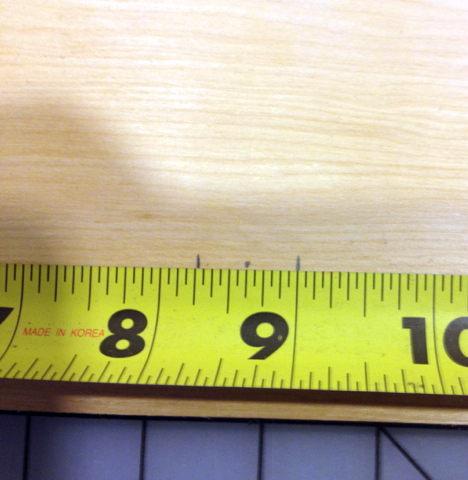
So we draw a line at the 9-inch mark on the board.

Then we flip the tape measure around...

...and mark 9 inches going the other way.

Now we have two marks that are less than an inch apart.

If you have managed to graduate with a design degree, or if you build things for a living, or have any visual acuity whatsoever, it's super-easy to eyeball the exact midpoint of two lines less than an inch apart.

Mark it, and that's it, you're done.

If you want to double-check, just run the tape measure, no math necessary. Here we see we've got 8 5/8.
Then flip the tape measure, and confirm we've got 8 5/8 going the other way.

The best part of this system is that it's foolproof. In other words, if I was dumb enough that I divided 18 by 2 and came up with 8, and marked 8 inches from each side, the two marks would be a lot wider than 1 inch apart, and I'd know I screwed up and would recalculate before cutting anything.
I can't remember which magazine, website or blog I first saw this tip on—it was years ago—so I cannot give credit where it's due. Nevertheless, I'm sure this is an old and fairly common carpenter's tip.
-
o1Favorite This
-
Q25Comment
Directory Company Profiles

Core77
Industrial Design
Resources
Industrial Design
Resources
-
Core77 Directory
Find the Best Industrial Design CompaniesGo -
Goddard, Inc.
Goddard Inc. is a full-service engineering and industrial design firm specializing in the developmen...
-
 Copenhagen Institute of Interaction Design
Copenhagen Institute of Interaction Design (CIID) is an international hub of creative minds. We shar...
-
Card79
CARD 79 gives form to future states by converging strategy, brand, and design. We excel in technical...
-
James Owen Design
We've been focused on robust and thorough design and product development consulting with a healthy d...
-
RKS Design
RKS is an award-winning global product design firm and innovation consultancy specializing in indust...
-
Jackson Hedden Inc
We design unique products for startups, companies, and everything in between. We believe good design...
-
Artiform Design
We give shape to the future by designing, refining, and engineering next-generation devices and expe...
K
{Welcome
Create a Core77 Account
Already have an account? Sign In
By creating a Core77 account you confirm that you accept the Terms of Use
K
Reset Password
Please enter your email and we will send an email to reset your password.
Comments
Another idea: If the round-down is 18 and round-up is 19, just skew the tape until it measures 20 diagonally, and mark at 10. If that's too strong an angle for the piece, you can always hold the tape so it measures 19, and mark at 9 1/2. This trick works great when you need to divide a piece into thirds or quarters or fifths or whatever, just by setting the diagonal so that you get a common divisor.
I was also going to espouse this method. I learned it from a Jimmy Diresta tips n tricks vid.
Why not buy drillbits and tape measures in mm's?
You've all got it wrong. Take another board of identical dimensions and mass, shave off even increments of board, and continously weight the shavving and the remaining board. Once the weight of the shaving and the remaining board are equal, you have reached the center of the board you started with. Then, either measure the remaining bard and transfer that measurment to the piece you want to cut, or simply lay the half sized piece on top of the piece needding cut and make a mark. Simple
As for those posting snotty remarks; really? Did your mama's not teach you anything? If you don't have anything nice to say.......
I'm a financial analyst and can reconcile billion dollar accounts to the penny. Ask me to measure something that's not 1/4, 1/2 or 3/4 and I can't figure it out. That's my husbands job. :)
You don't even need a tape measure.
But cubits are even hard to find the half of.
Faith? Baddum ching.
We like things to be more difficult.
From a manufacturing point of view this is never the case.
So stick to two references and just do the very very simple math ;)
http://www.amazon.com/Lufkin-HI-VIZ-Self-Centering-Measure-L725SCT/dp/B002H6WFJY
http://www.pushstick.com/webview/mid-point.jpg